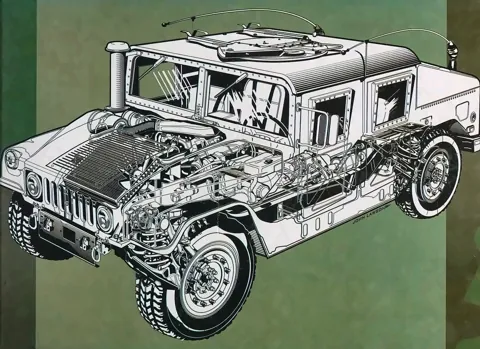
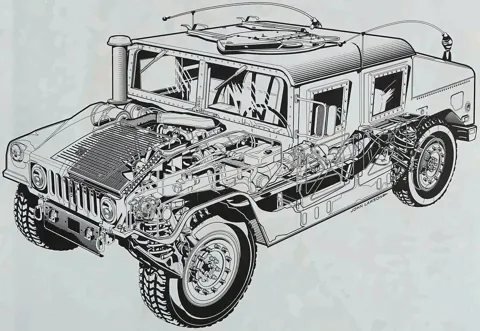
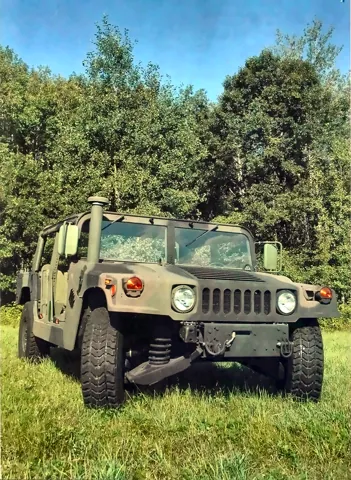
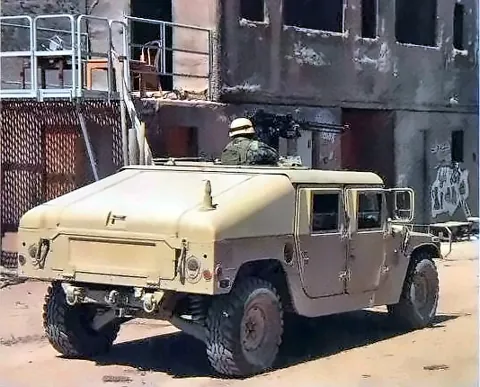
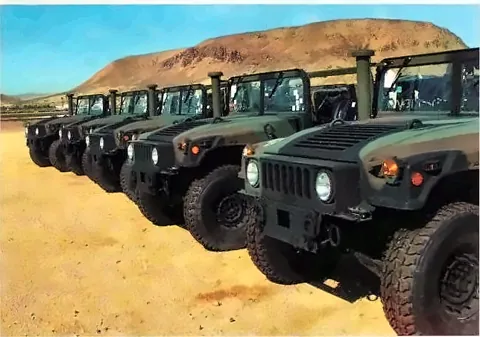
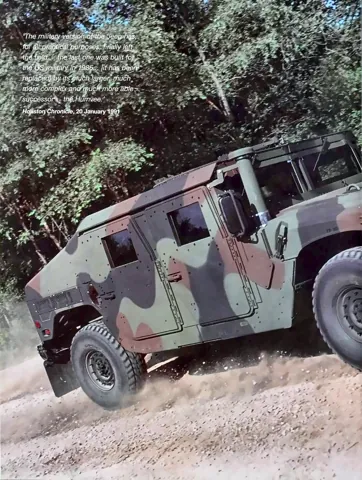
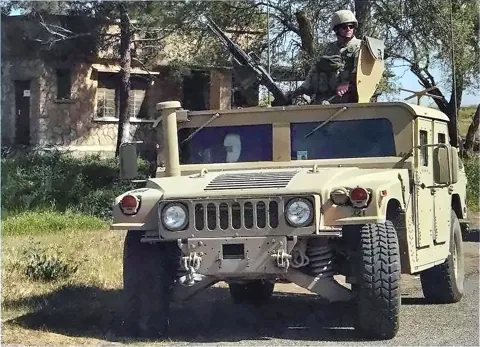
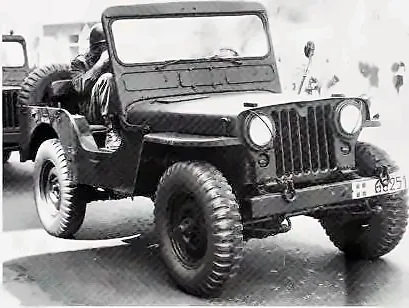
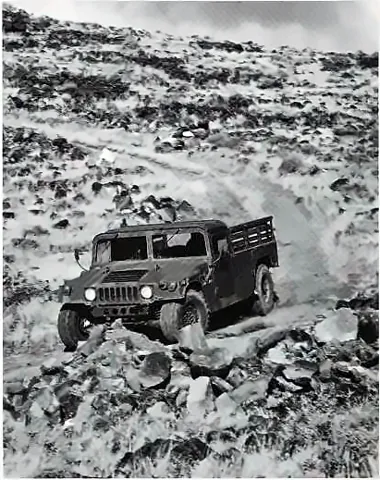
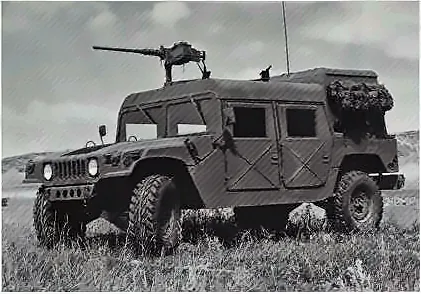
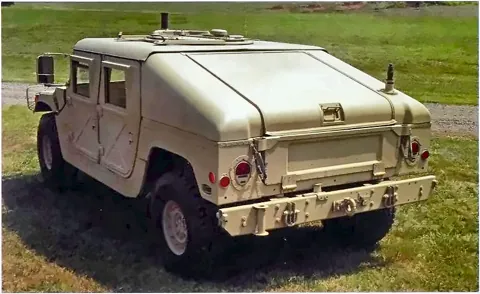
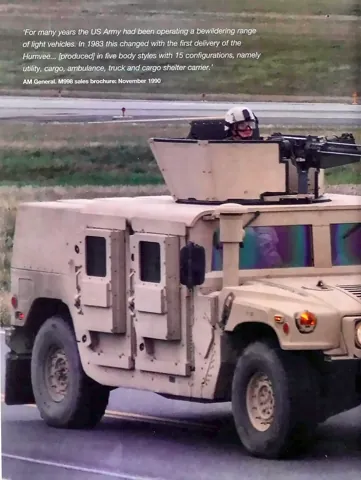
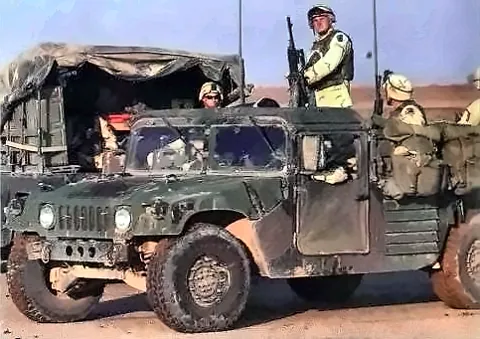
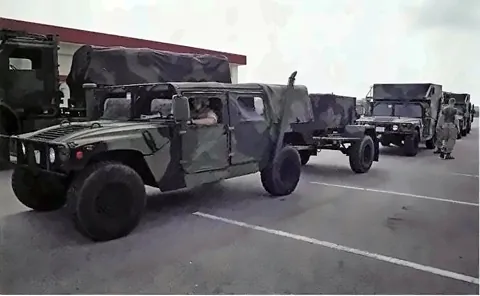
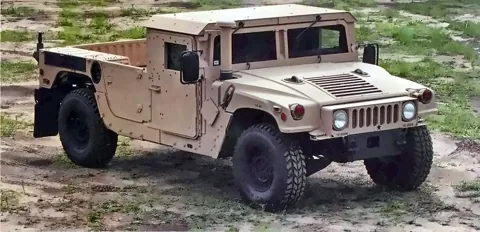
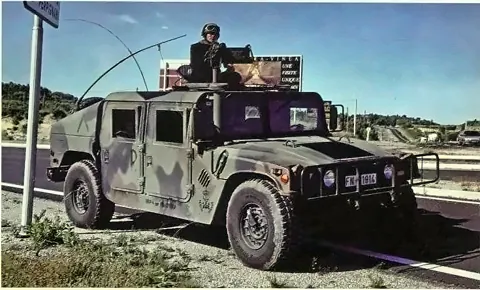
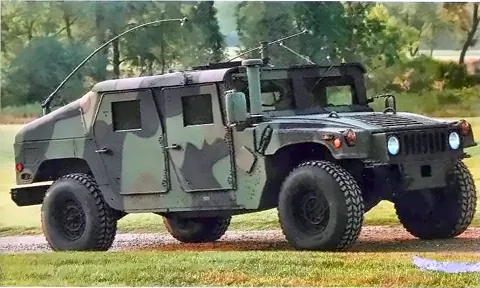
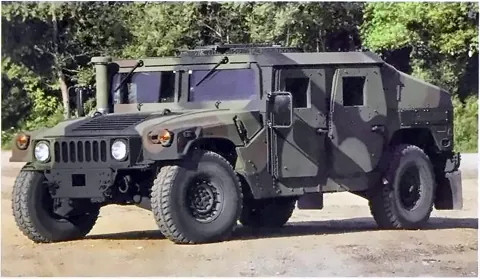
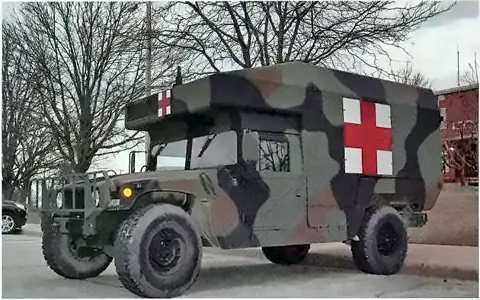
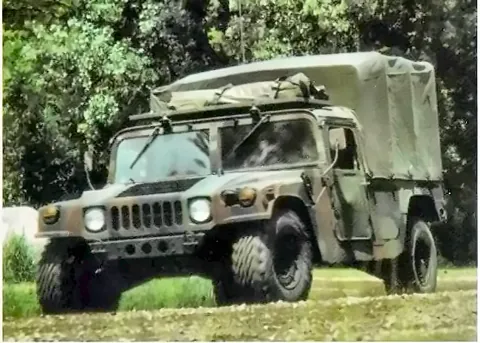
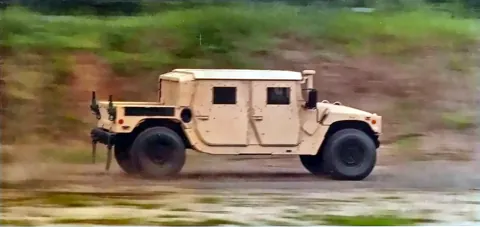
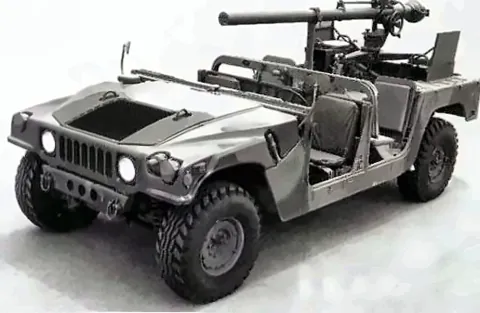
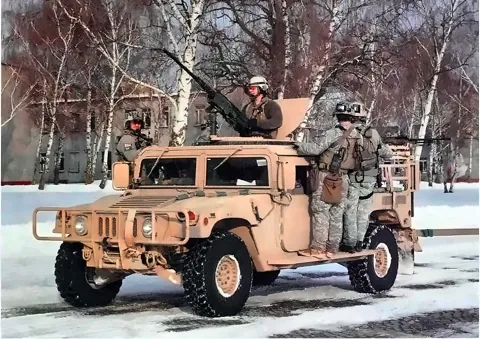
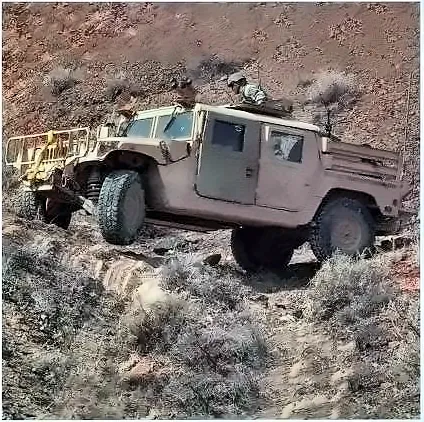
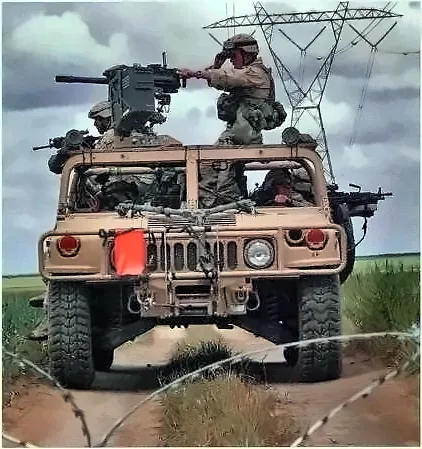
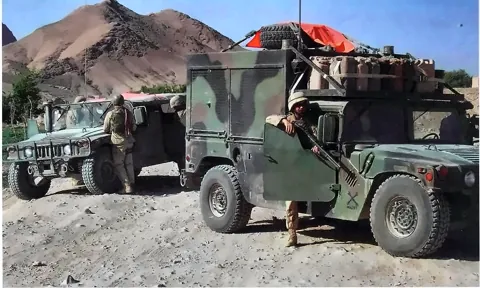
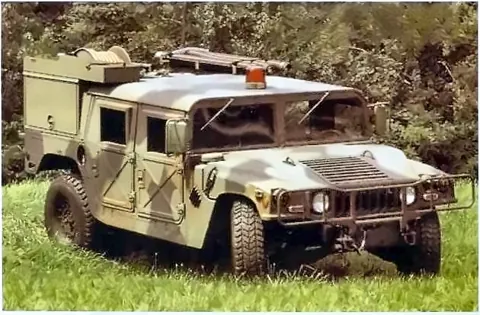
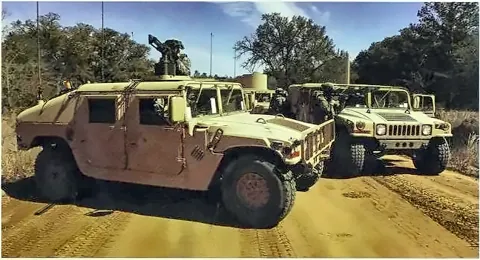
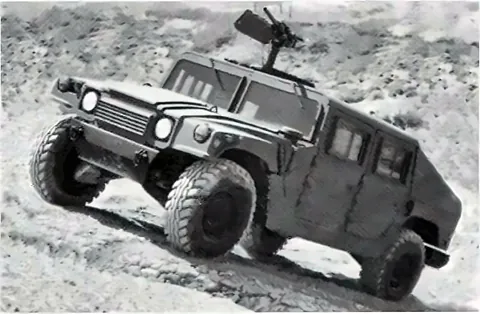
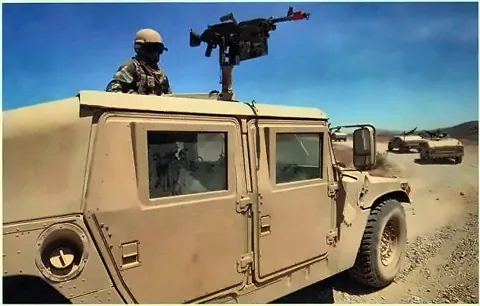
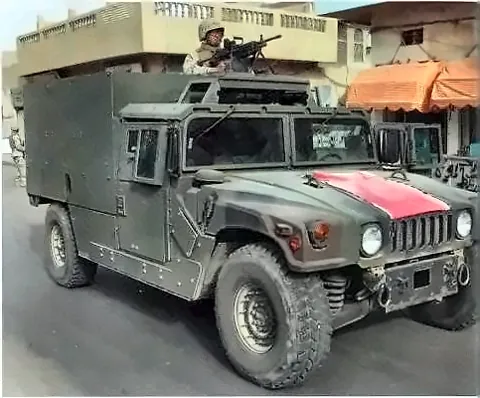
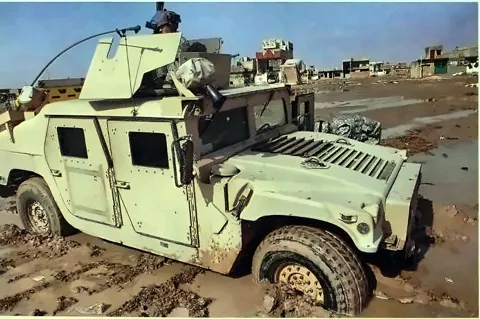
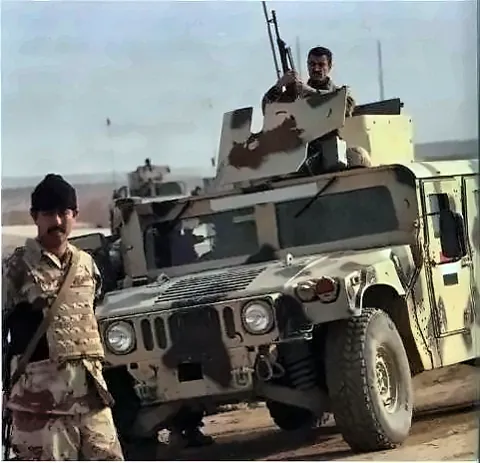
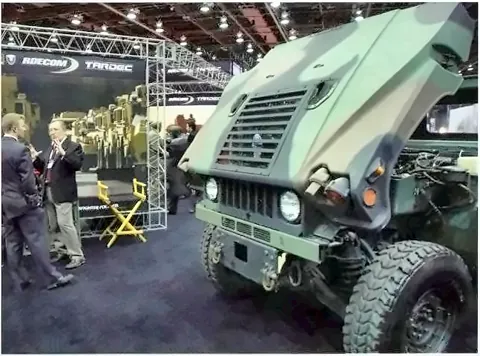
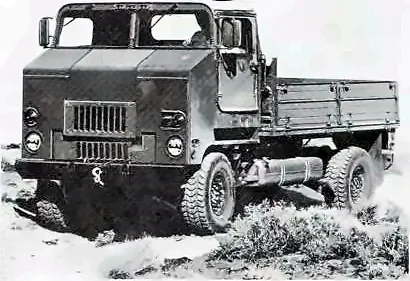
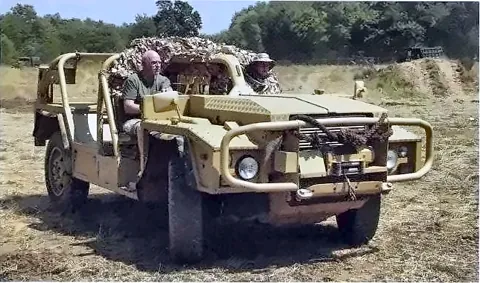
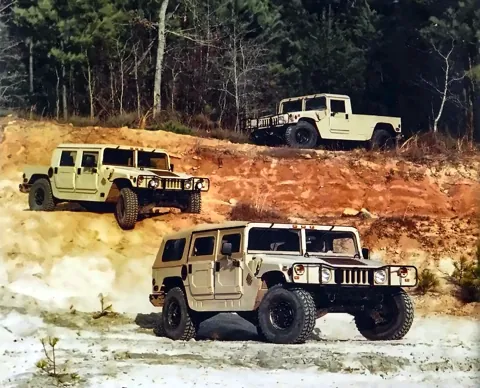
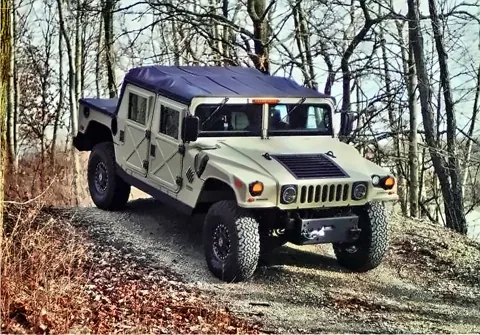
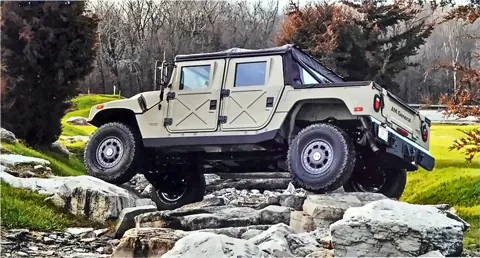
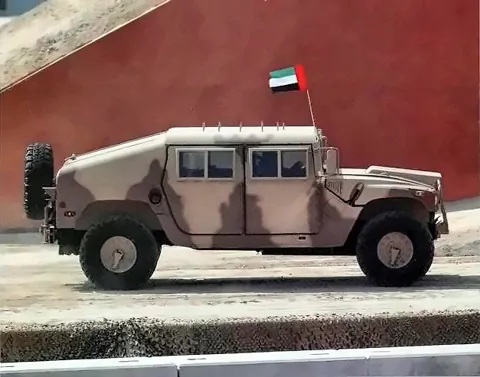
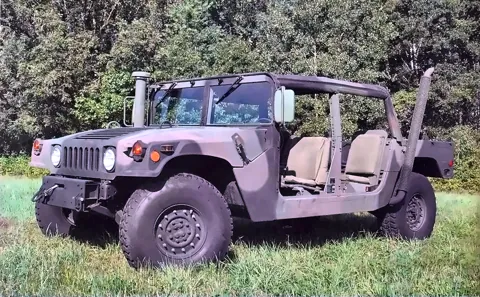
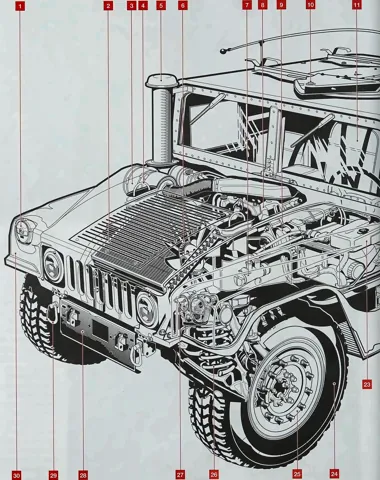
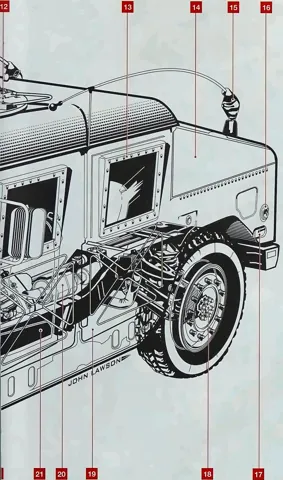
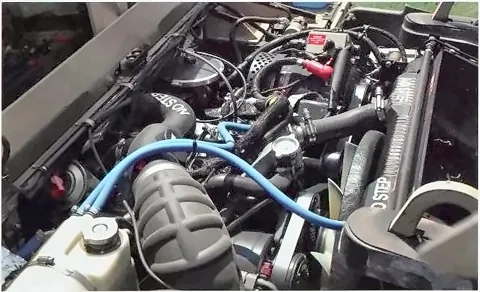
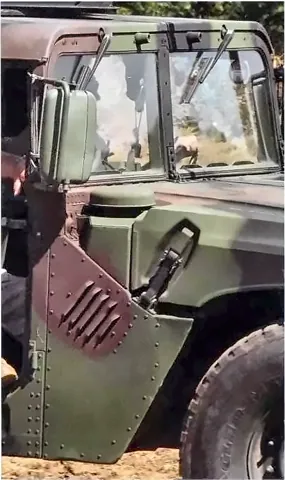
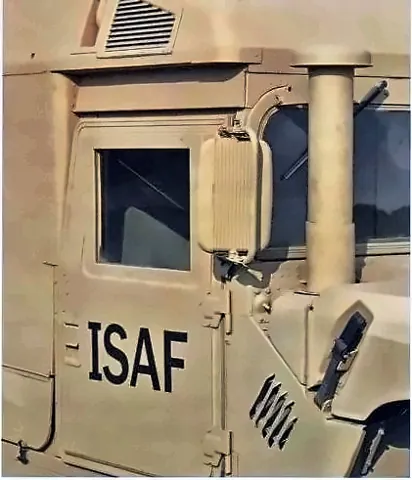
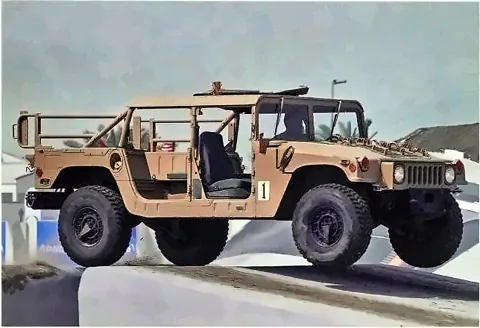
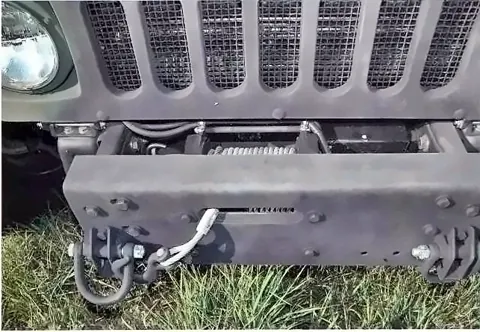
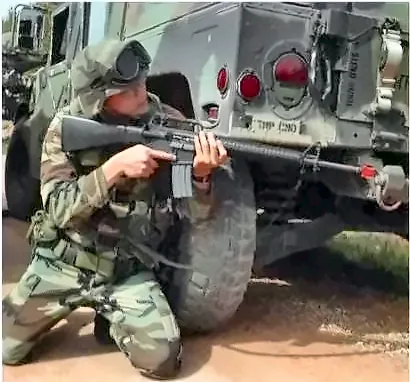
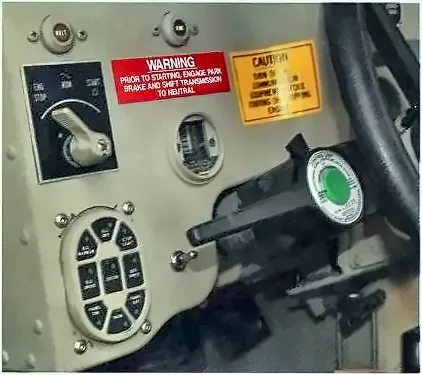
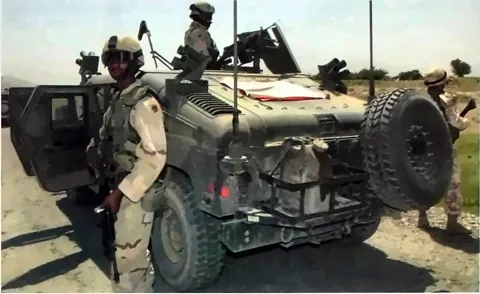
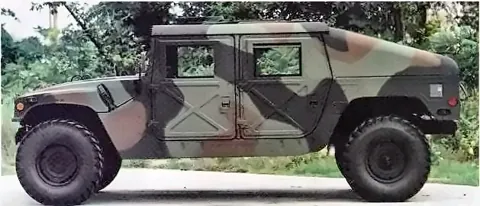
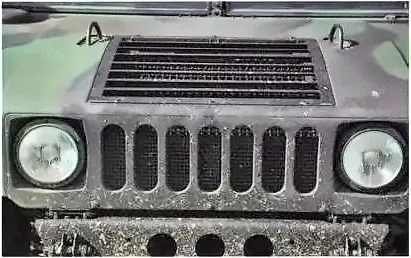
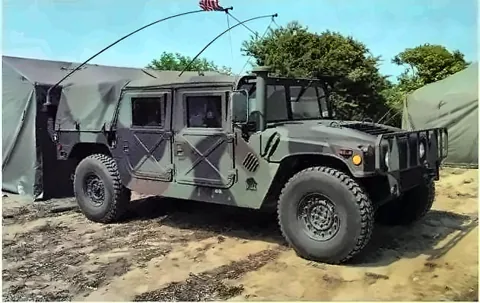
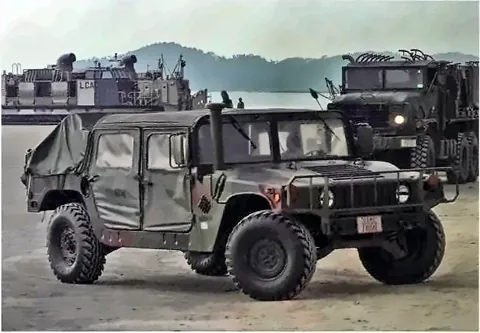
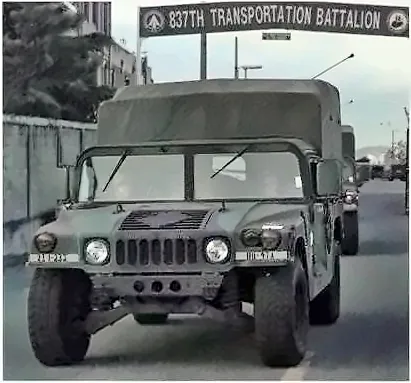
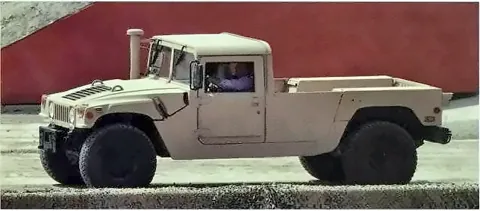
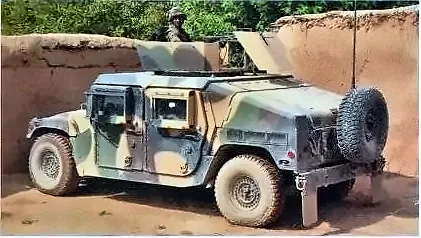
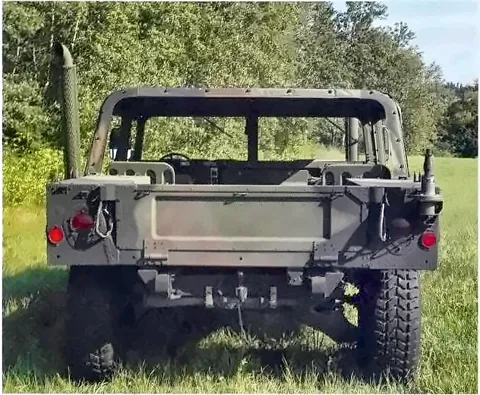
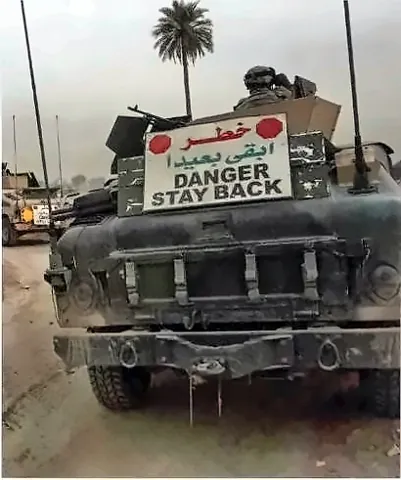
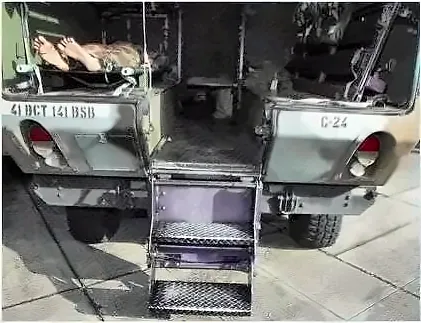
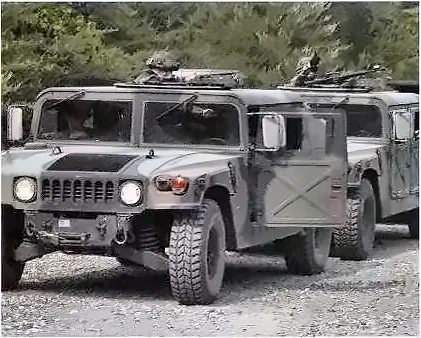
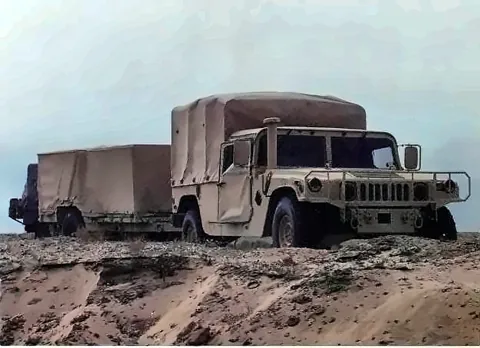
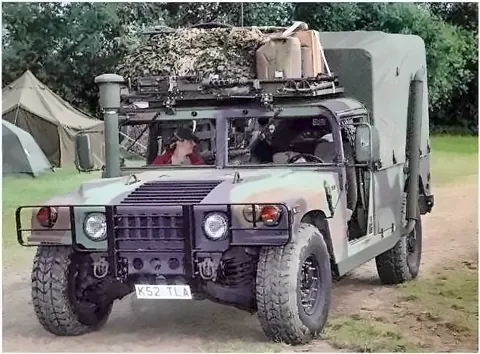
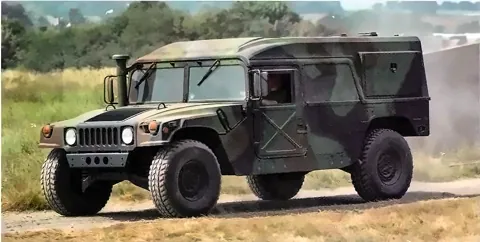
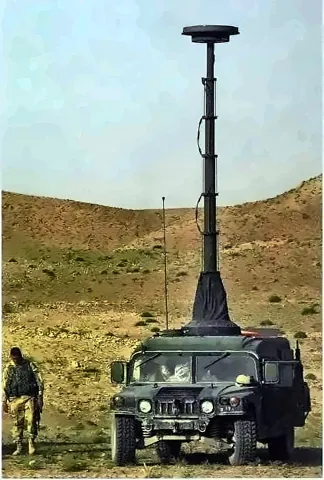
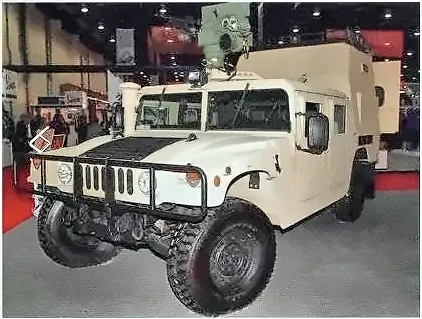
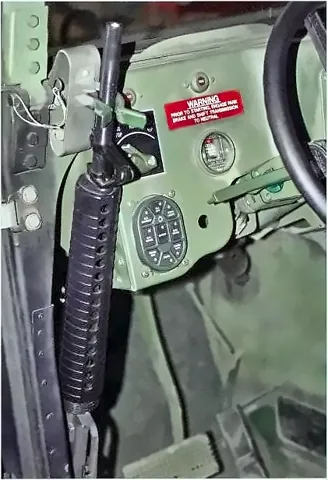
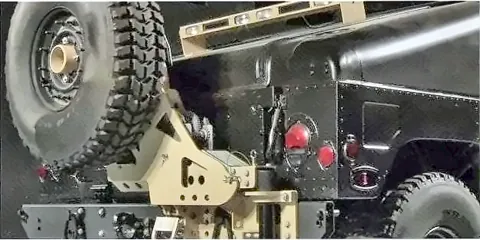
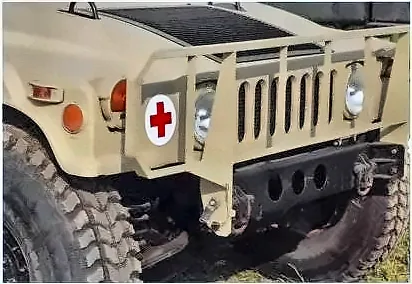
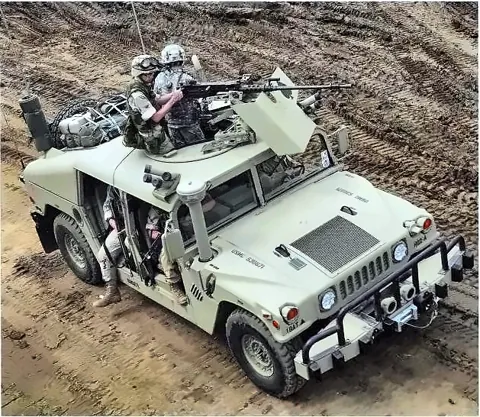
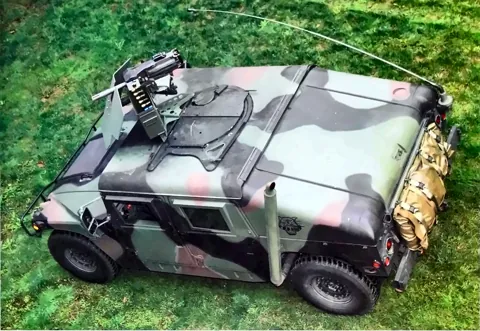
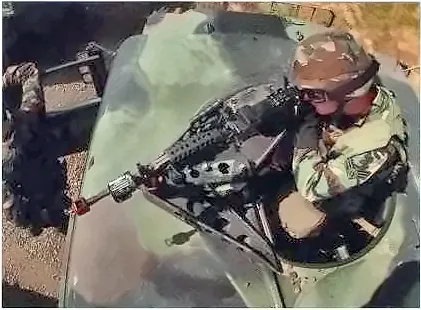
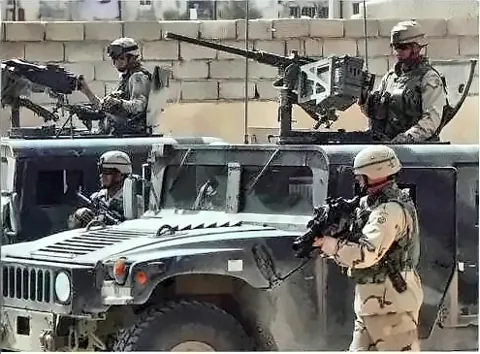
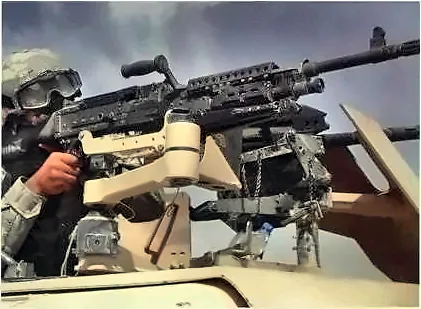
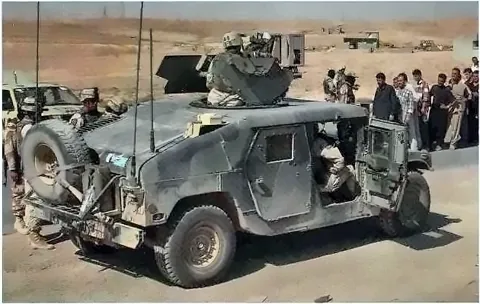
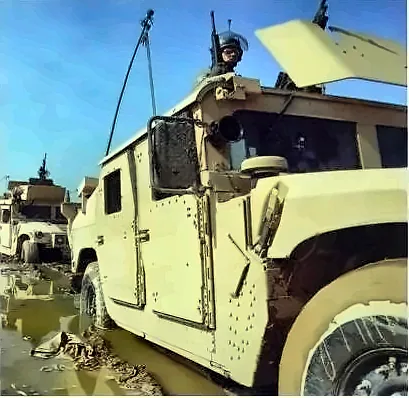
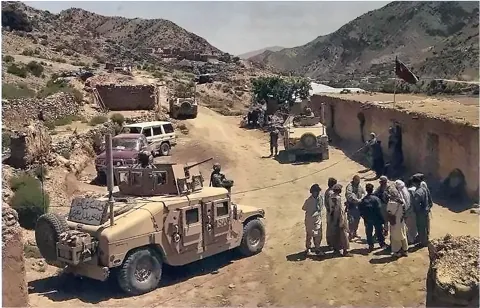
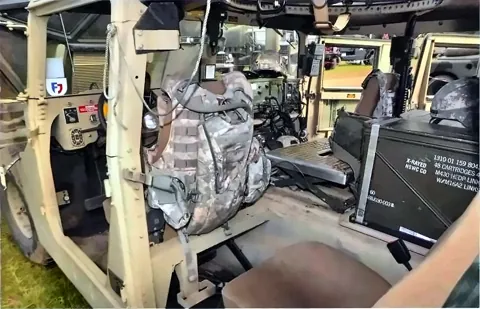
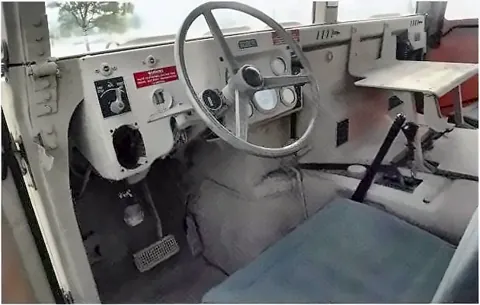
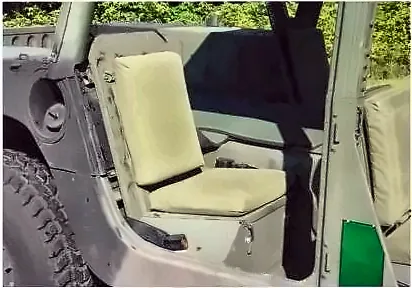
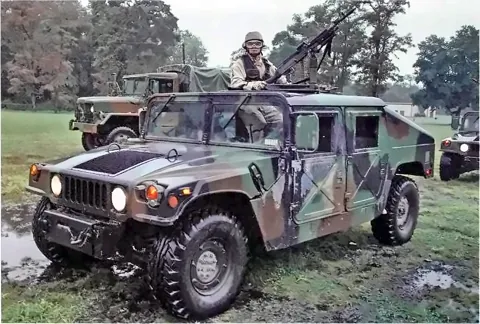
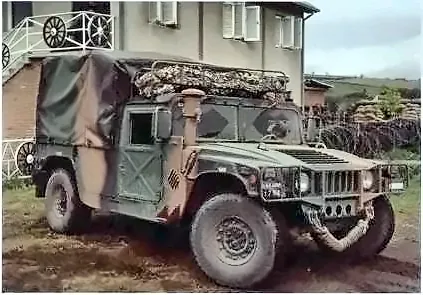
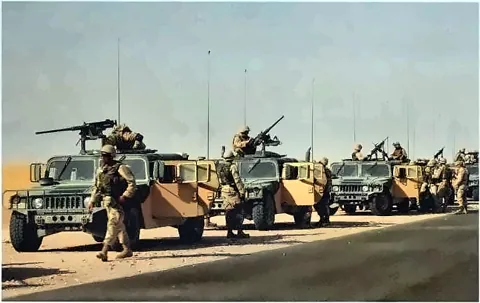
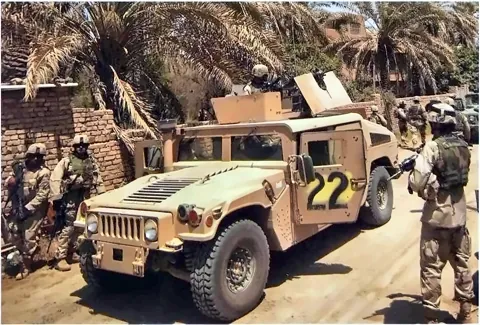
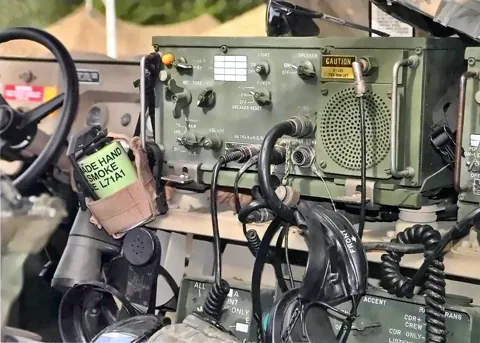
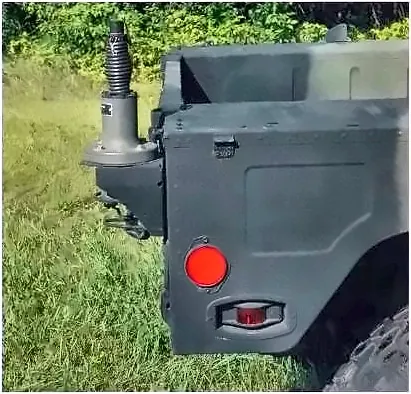
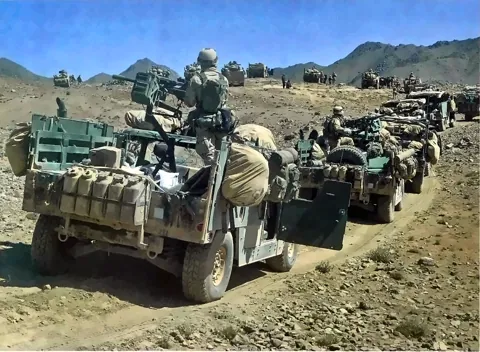
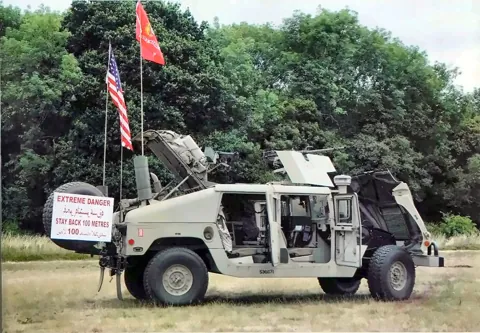
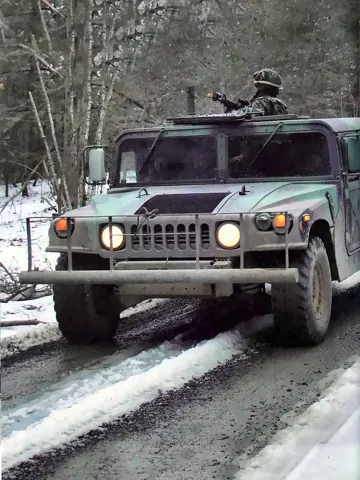
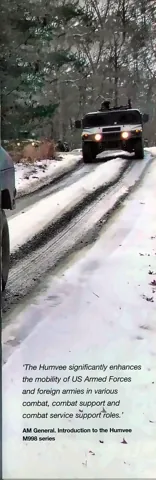
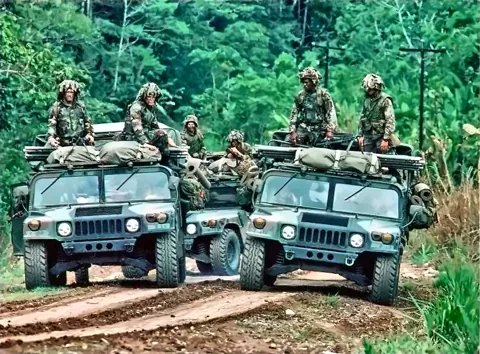
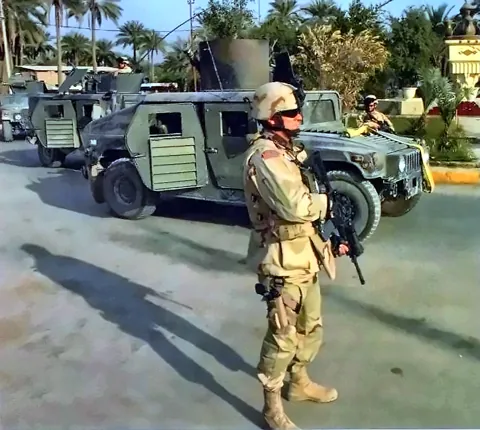
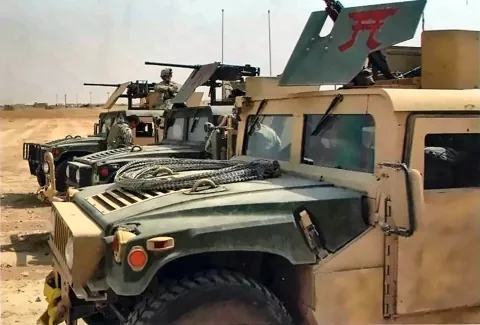
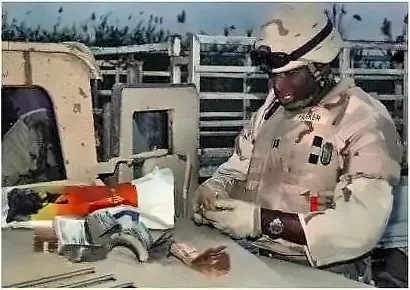
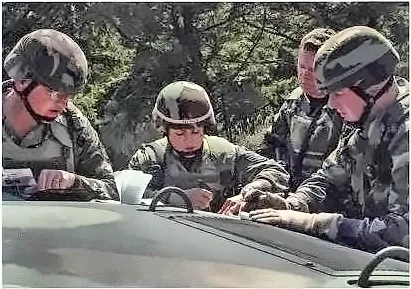
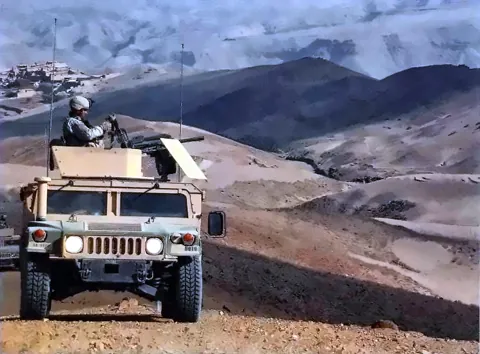
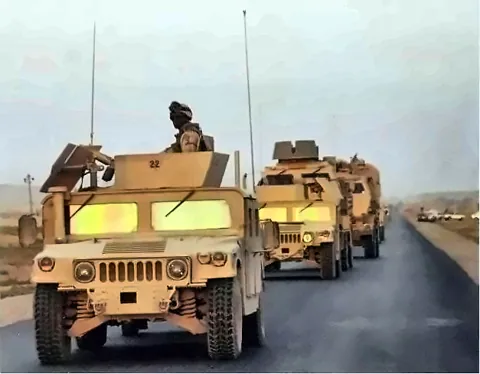
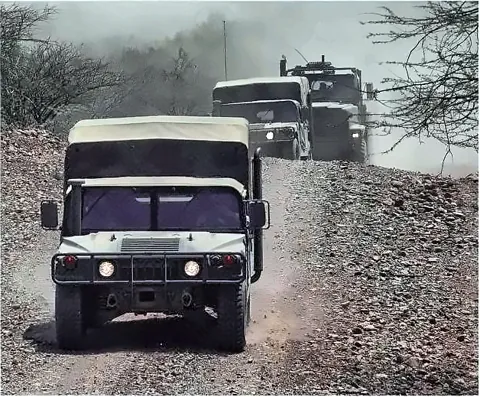
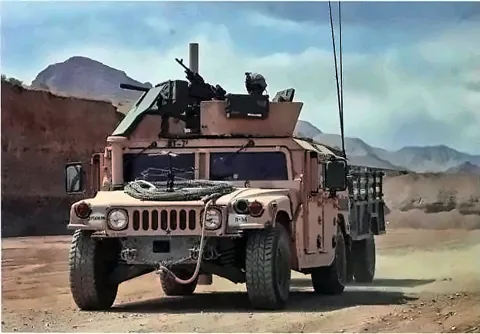
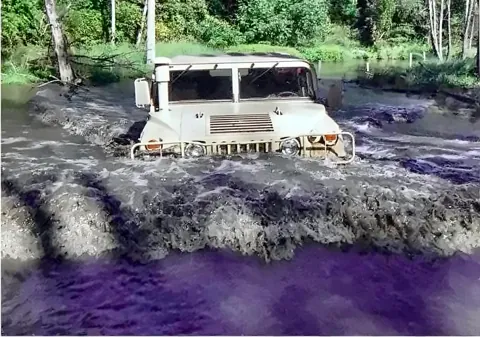
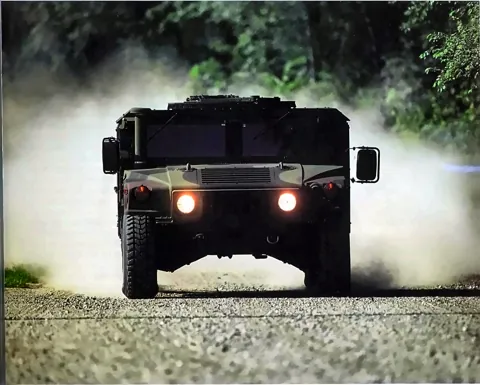
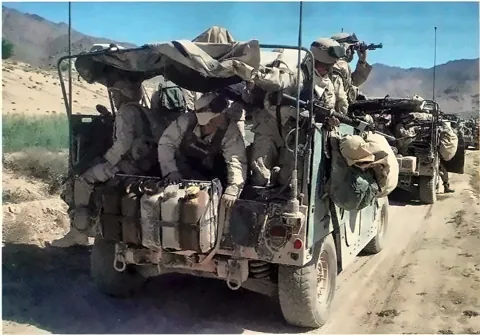
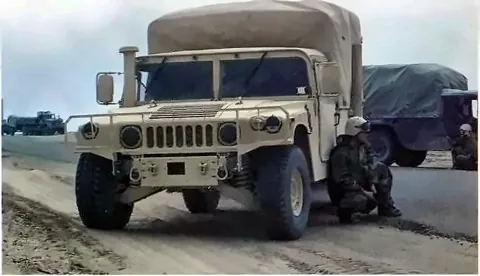
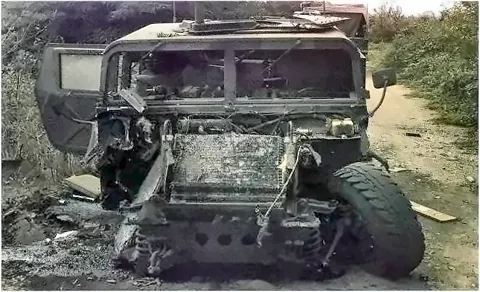
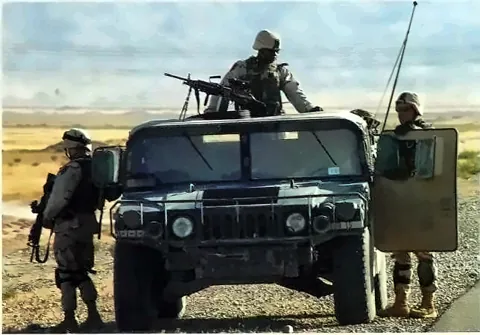
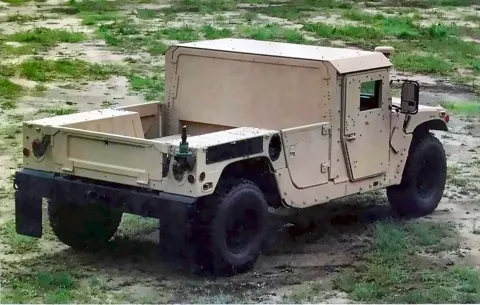
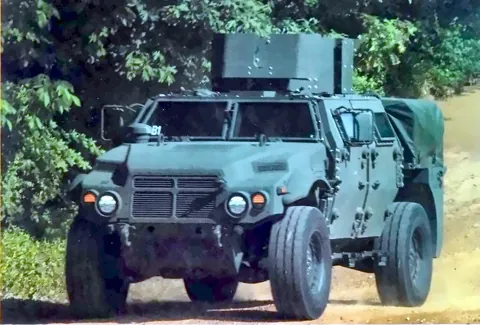
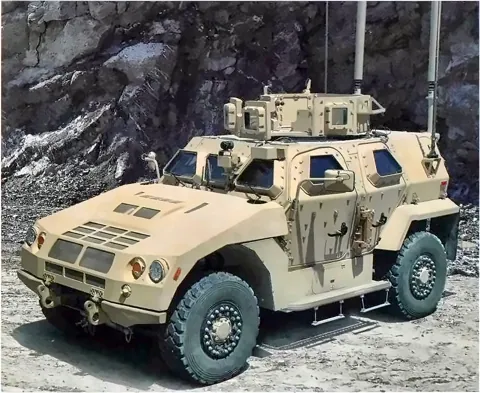
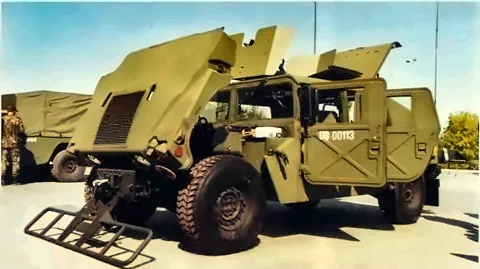
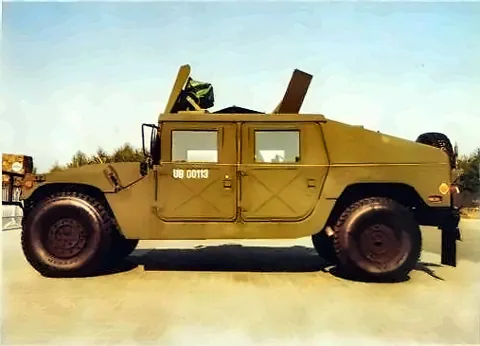
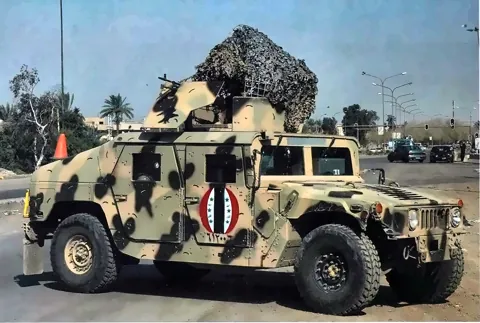
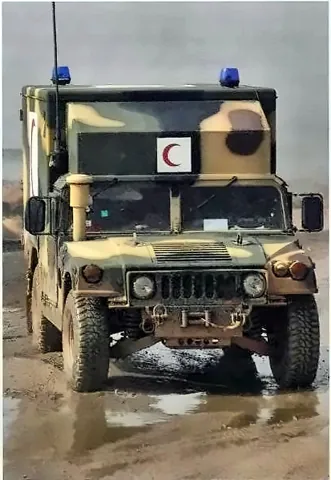
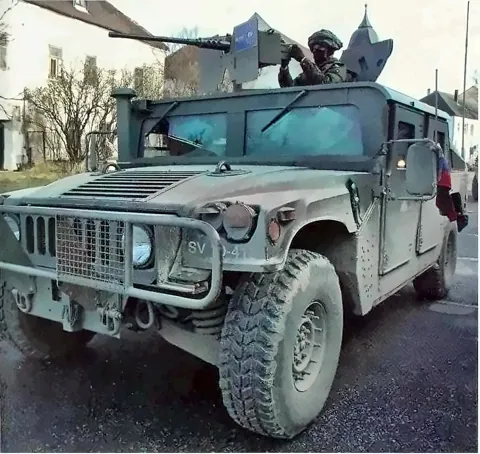
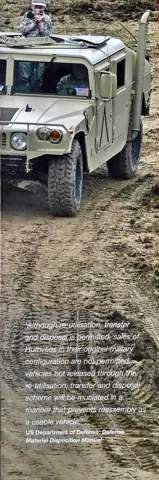
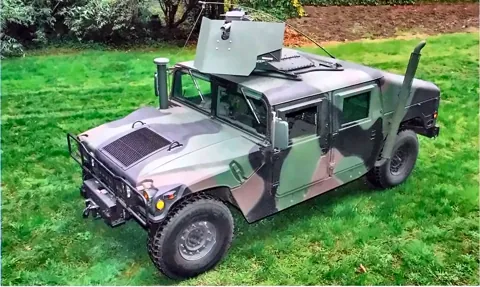
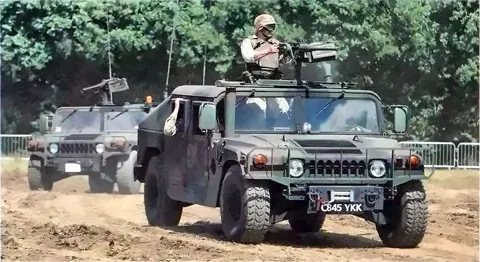
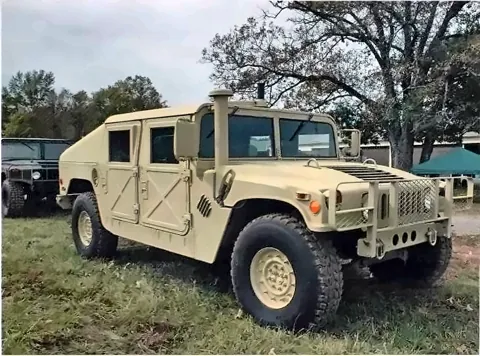
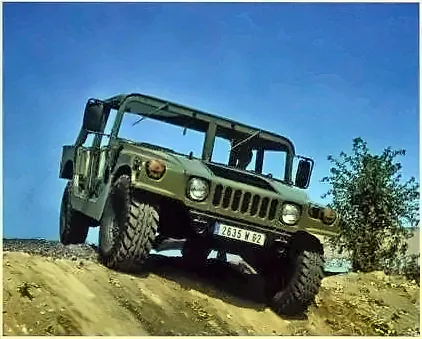
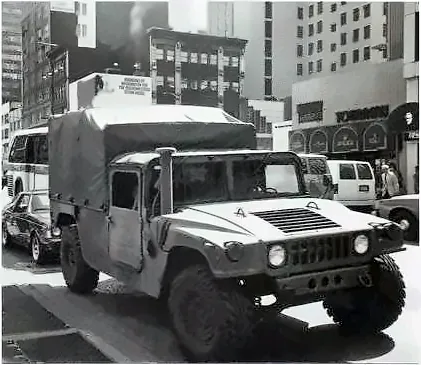
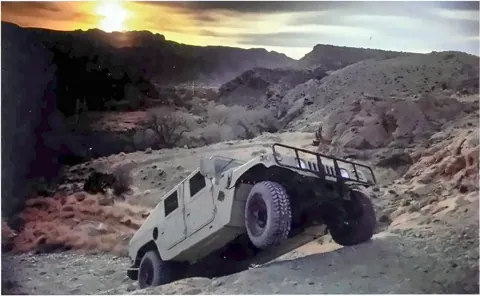
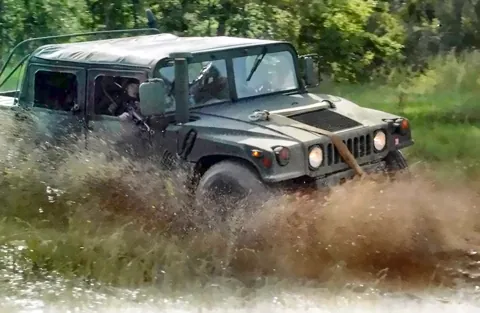
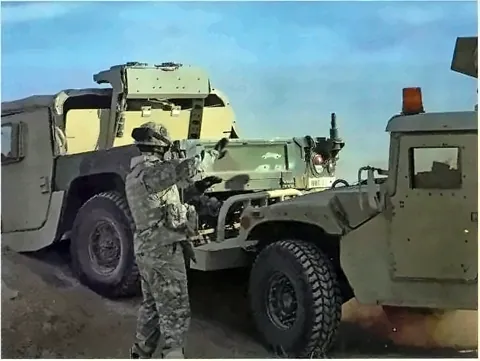
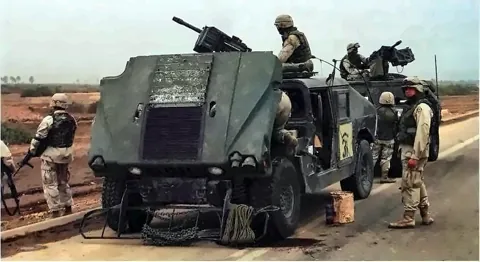
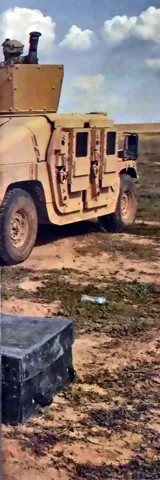
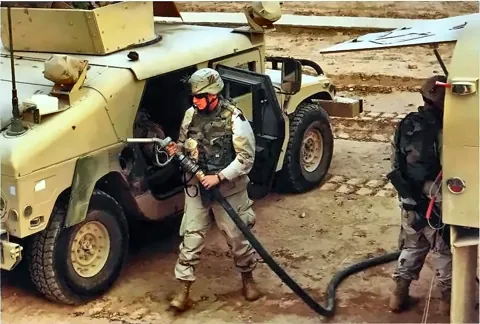
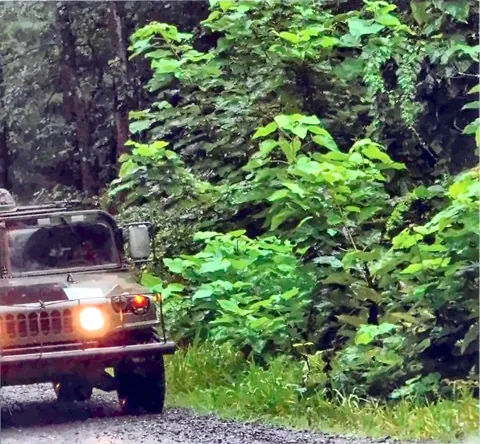
The cargo/troop carrier, in this case as the M1038 winch-equipped variant, is considered to be the base vehicle of the Humvee family. This example has been set up in the four-door configuration, albeit the doors and the cargo cover are not fitted.
Photo: David Doyle · page 6 · p006-img01
No caption in the book.
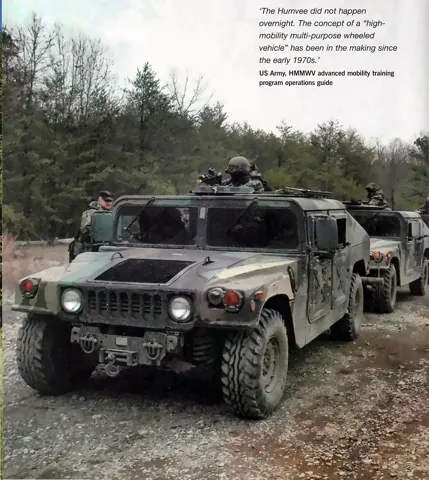
Photo: US Department of Defense · page 7 · p007-img01
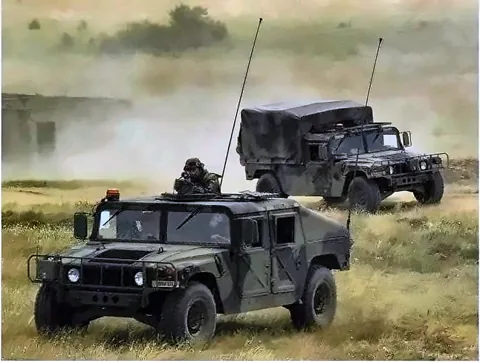
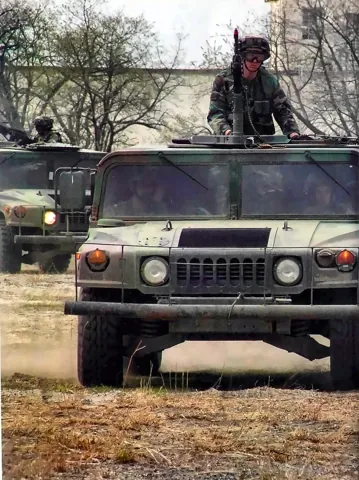
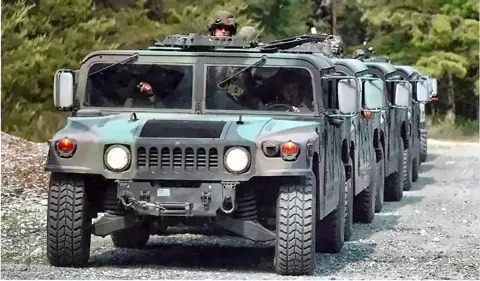
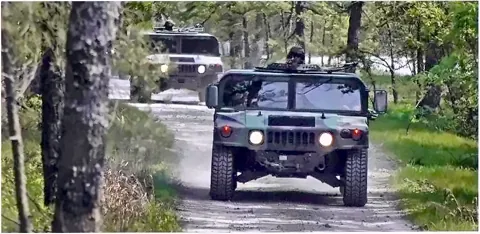
US Air Force airmen preparing for a run during convoy training at Fort Dix, New Jersey, March 2007. The lead vehicle is a winch-equipped M1026 armament carrier.
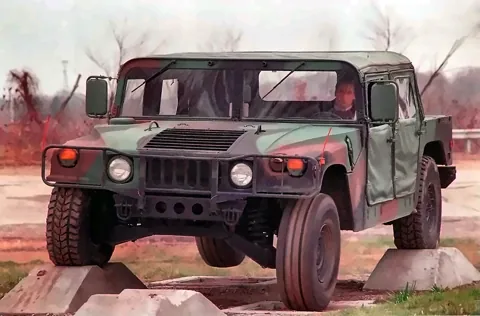
Photo: US Department of Defense · page 8 · p008-img01
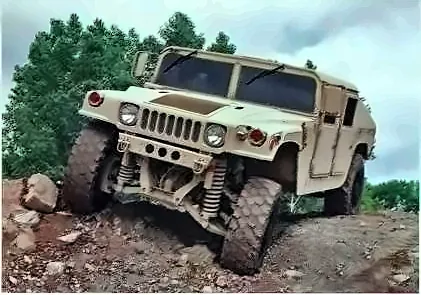
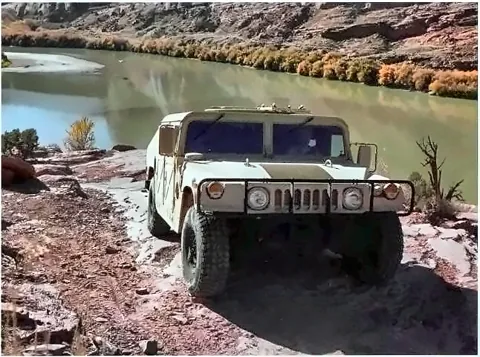
Despite having two wheels clear of the ground, this four-door M998 cargo/troop carrier demonstrates that plenty of traction is still available.
Photo: AM General · page 9 · p009-img01
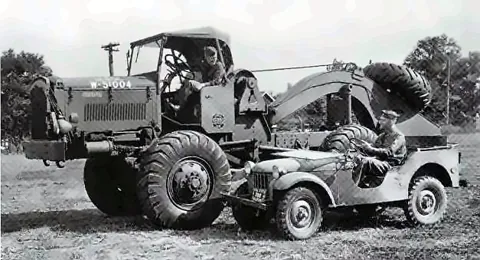
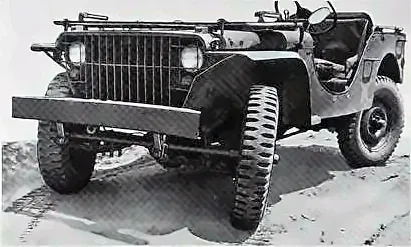
Where it all began! In 1940 the US Quartermaster Corps asked the US motor industry to develop a small four-wheel-drive utility vehicle. American Bantam delivered their prototype for trials in September 1940, and subsequently constructed 70 pre-production versions of what was described as the BRC-60.
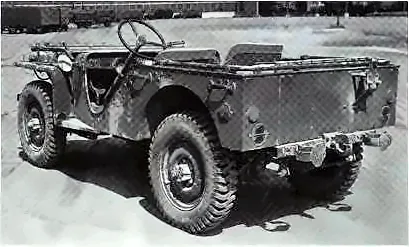
Photo: David Doyle · page 10 · p010-img01
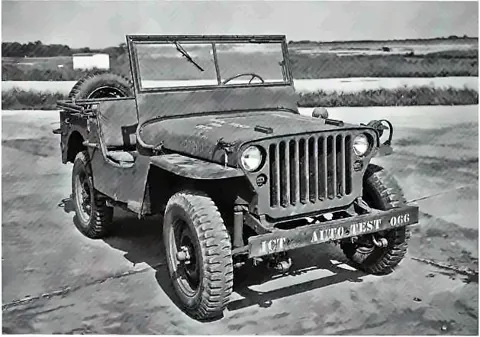
Following the success in trials of the BRC-60, American Bantam constructed 2,642 examples of the improved BRC-40... before being eliminated from future contracts in favour of Ford and Willys-Overland.
Ford's contribution to what became known as the Jeep project was the GP. Of the 3,699 examples constructed during 1941, before the ‘standardised’ Jeep was adopted, 50 were equipped with four-wheel steering in an effort to improve mobility.
By November 1941 American Bantam was out of the picture. Over the next four years, Ford and Willys-Overland constructed a total of 639,245 ‘standardised’ Jeeps between them; Ford’s contribution was 277,896 examples of the GPW, whilst Willys built 361,349 examples of the MB.
Photo: US Signals Corp · page 10 · p010-img04
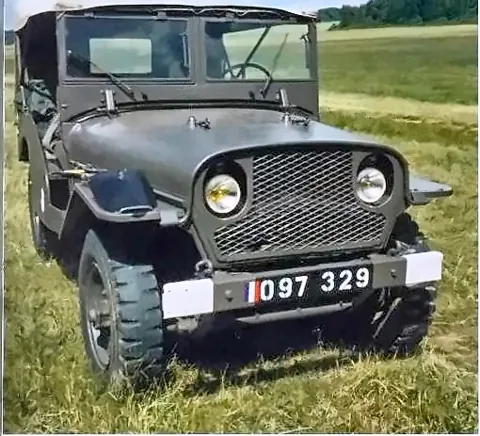
By the end of the 1940s, most European nations had plentiful supplies of American Jeeps. Believing that the original design could be bettered, the French Delahaye company came up with the VLR-D, featuring independent suspension by torsion bar and a dry-sump engine. It was not a success.
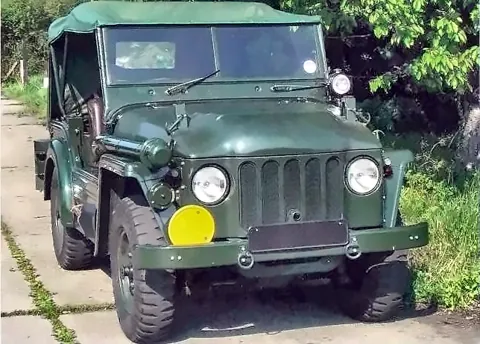
Similarly believing that the Jeep concept could be improved, between 1952 and 1955 the British Army purchased some 14,000 examples of the Rolls-Royce-engined FV1801 Austin Champ. Advanced features included torsion bar independent suspension, built-in waterproofing, and five forward and reverse speeds. Although more successful than the Delahaye, it was soon replaced by the far simpler Land Rover.
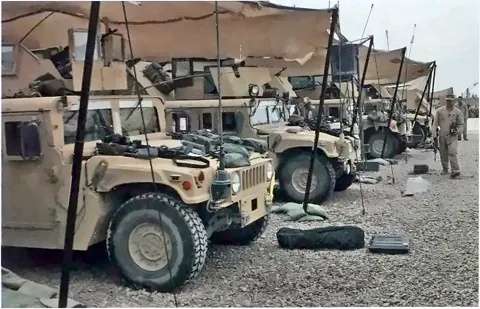
By the time the Humvee was launched in 1984, technology had caught up with the Army’s aspirations, and features such as independent suspension, traction control and electronic engine management systems had become both commonplace and reliable. The photograph shows a line-up of brand new M1152 cargo/troop/shelter carriers at the US Army’s Fleet Support Division.
Photo: US Department of Defense · page 11 · p011-img03
Although never conceived as an armoured vehicle, the Humvee has been progressively ‘hardened’ throughout its 25-year life in response to experience gained in service. This is the M1151 expanded capacity armament carrier, equipped with the so-called ‘integrated armour package’ (IAP).
Photo: AM General · page 12 · p012-img01
No caption in the book.
page 13 · p013-img01
Photographed in April 2004, Sergeant First Class Eric Anderson maintains security during an inspection of abandoned buildings in Dibbis, Iraq. The vehicle is the M1114 expanded capacity, up-armoured armament carrier.
Photo: US Department of Defense · page 14 · p014-img01
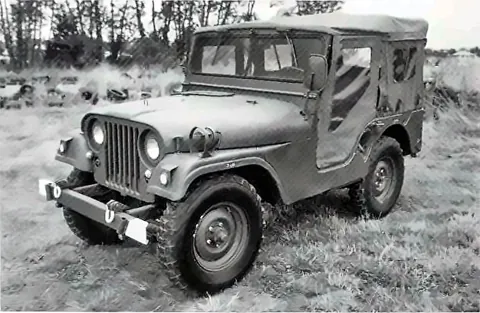
The US Army’s first post-war Jeep was the Willys MC – or M38A1 – of 1950. Based on the civilian CJ3A, it featured a 24V electrical system and built-in waterproofing, but otherwise differed little from the wartime MB/GPW.
In 1952 the Willys MC was joined by the improved MD, or M38A1. The original side-valve Go-Devil engine, which had also been used in the wartime MB, was replaced by the Hurricane, featuring overhead inlet valves.
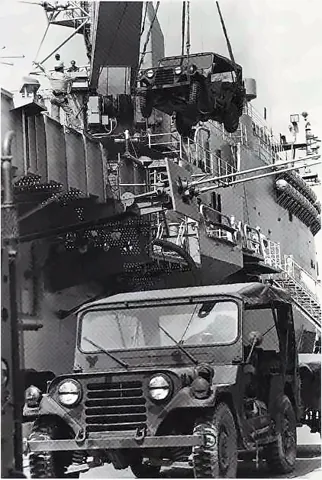
Entering production in 1960, the independently sprung M151 was developed by the Ford Motor Company as a replacement for earlier Jeep models. The swing-axle suspension set-up led to handling problems, which, despite the appearance of improved A1 and A2 variants, were never properly resolved.
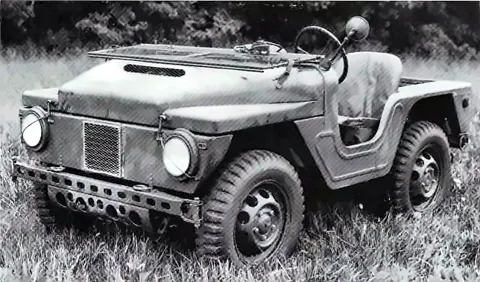
The US Marine Corps’ lightweight M422 Mighty Mite of 1960 was developed by American Motors with air-portability in mind. The unconventional design featured aluminium construction, a V4 air-cooled engine and independent suspension using quarter-elliptical springs.
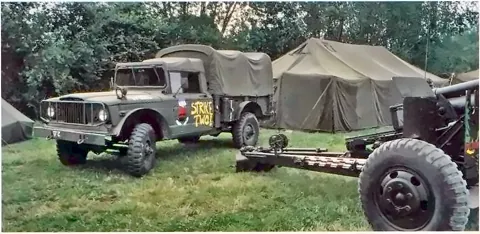
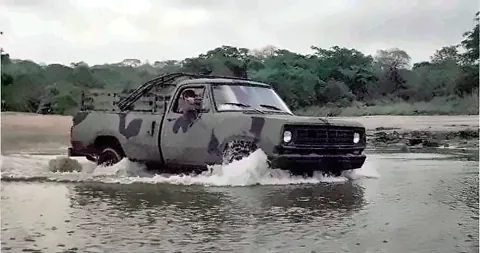
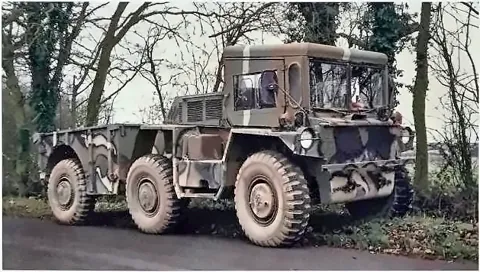
Introduced in 1967, and rated at 1.25 tons, the Kaiser Jeep M715 was designed to supersede the 0.75-ton class that had originated in World War Two, and was considered an interim replacement for the Dodge M37.
Dating from 1973, and forming part of the ‘commercial utility cargo vehicle’ (CUCV) family, the Dodge M880 1.25-ton 4x4 and 4x2 truck was based on the Chrysler Corporation’s commercial W200 pickup truck. It was designed to replace both the M715 and the M37.
Photo: US Department of Defense · page 16 · p016-img01
The high-mobility amphibious M561 ‘Gama Goat’ was manufactured by Condec (Consolidated Diesel Electric Corporation), and was a genuine attempt at breaking the mould. Rated at 1.25 tons, and featuring four-wheel steering and a 6x6 or 6x2 driveline, the two components of the vehicle were designed to pitch and roll relative to one another to ensure maximum cross-country ability. Sadly, it was not a success.
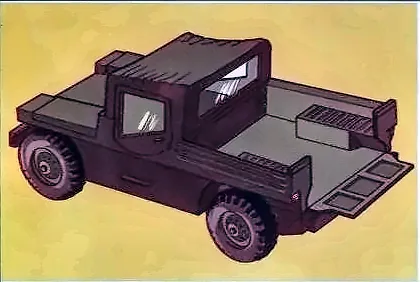
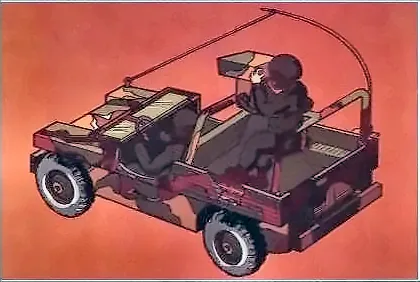
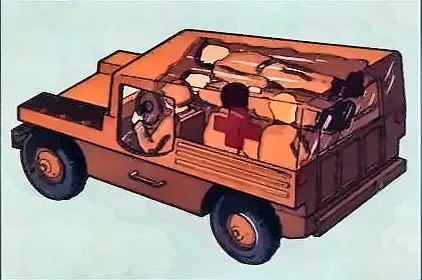
These simple sketches, showing alternative configurations for the vehicle, formed part of TACOM’s (Tank-Automotive and Armaments Command) 1979 proposal for a new high-mobility multi-purpose wheeled vehicle.
Photo: TACOM · page 17 · p017-img01
These simple sketches, showing alternative configurations for the vehicle, formed part of TACOM’s (Tank-Automotive and Armaments Command) 1979 proposal for a new high-mobility multi-purpose wheeled vehicle.
Photo: TACOM · page 17 · p017-img02
These simple sketches, showing alternative configurations for the vehicle, formed part of TACOM’s (Tank-Automotive and Armaments Command) 1979 proposal for a new high-mobility multi-purpose wheeled vehicle.
Photo: TACOM · page 17 · p017-img03
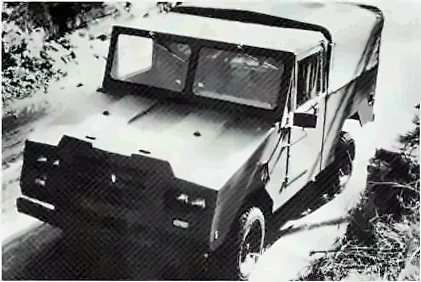
AM General’s prototype for the XM966 project was derived from proposals originally developed by FMC (Food Machinery Corporation) for the XR-311.
Photo: AM General · page 19 · p019-img01
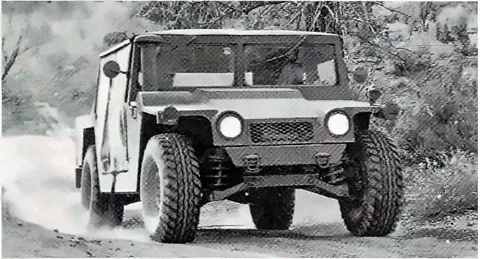
This is AM General’s submission to the XM998 project that superseded the XM966 in 1981. Although the shape and general appearance of the vehicle are close to that of the production version, there are noticeable differences in the radiator grille and in the top-hung windscreen.
Photo: AM General · page 20 · p020-img01
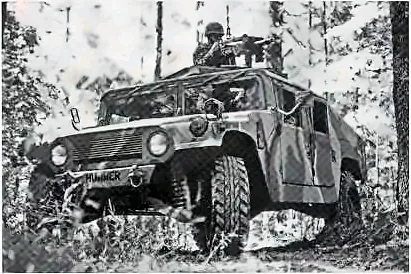
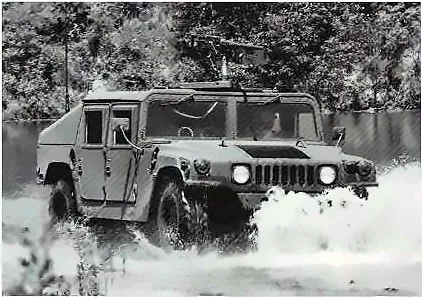
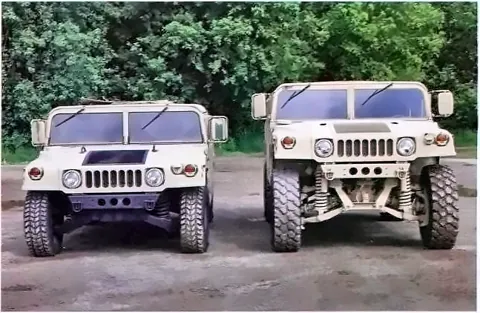
Pre-production Humvees were extensively tested in various roles during 1984 before production proper got under way. These vehicles can be identified by the four, rather than three, holes perforating the front cross-member.
Photo: AM General · page 20 · p020-img02
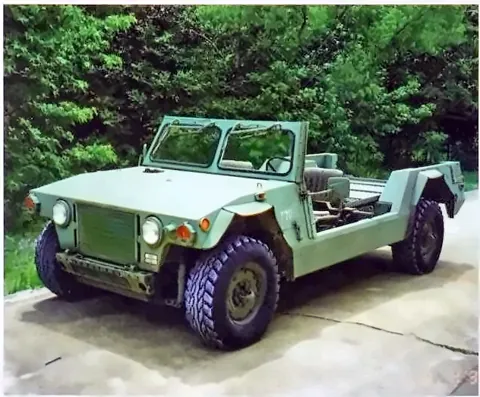
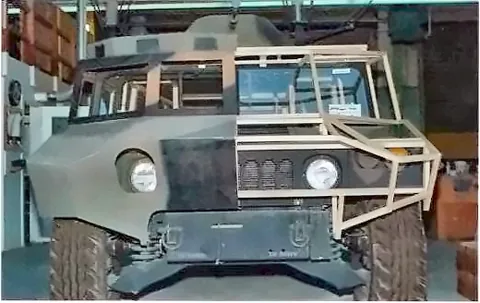
Although the ‘modular desert vehicle’ had originated with American LaFrance, it subsequently passed to FMC, where it became known as the ‘modular military vehicle’ (MMV). In this form, it was put forward as a possible contender for the Humvee project.
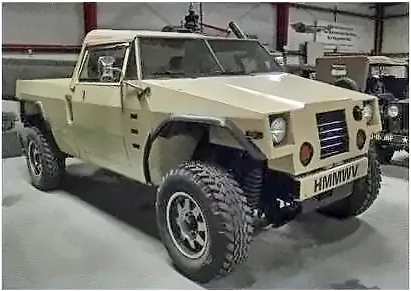
The General Dynamics submission to the XM998 project was this Deutz-engined ‘expanded capacity vehicle’, reportedly using some 75 per cent commercial parts. The prototype is on display at the Heartland Museum of Military Vehicles in Lexington, Nebraska.
Photo: David Doyle · page 22 · p022-img01
Teledyne Continental’s XM998 prototype was powered by an International Harvester V8 diesel engine, and was based on the Cheetah off-road vehicle that the company had acquired from Mobility Technology International. The prototype has survived and is on show at the Veterans Memorial Museum, Huntsville, Alabama.
Photo: David Doyle · page 22 · p022-img02
Pre-production M1025 armament carrier photographed during testing.
Photo: AM General · page 23 · p023-img01
AM General’s Humvee squad carrier variant, seen here in pre-production form, was not adopted by the US Army. The vehicle had a fully enclosed crew and passenger compartment and could transport a fully equipped eight-man infantry unit plus two additional crew members.
Photo: AM General · page 23 · p023-img02
Rear view of the distinctive beetle-backed armament carrier; the hatchback can be opened either from the top or the bottom.
Photo: David Doyle · page 23 · p023-img03
The rare M1116 base security/personnel carrier is deployed by the US Air Force for airfield defence. This photograph was taken during a demonstration at McChord Air Force Base, Washington, in July 2007.
Photo: US Department of Defense · page 24 · p024-img01
No caption in the book.
page 25 · p025-img01
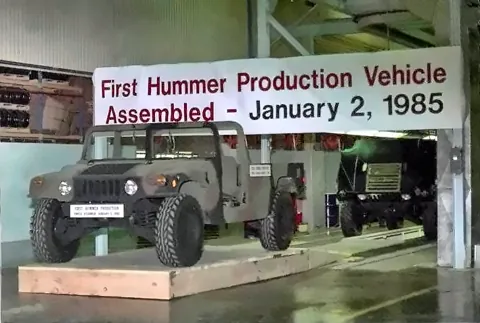
The first Humvee, an M998 cargo/troop carrier, came off the production line on 2 January 1985. The company predicted that, by mid-year, production would reach 65 vehicles a day.
Photo: AM General · page 26 · p026-img01
The initial Humvee programme comprised 16 variants, retrospectively described as the M998A0 series. The photograph shows the beetle-backed M1025 armament carrier (foreground) and the M998 cargo/troop carrier configured with two doors and a high cover over the cargo area.
Photo: AM General · page 27 · p027-img01
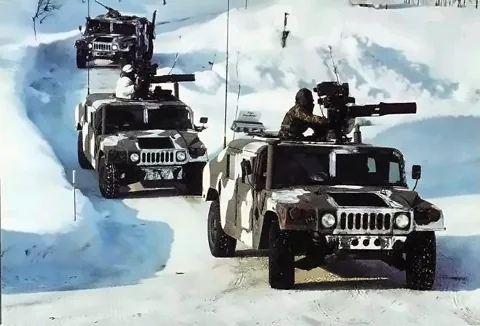
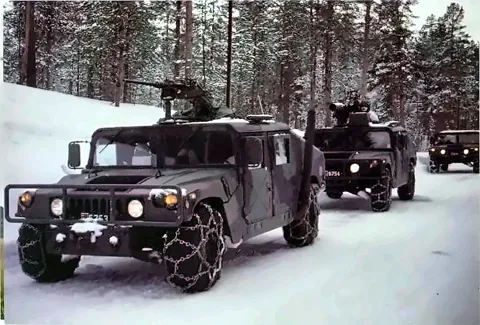
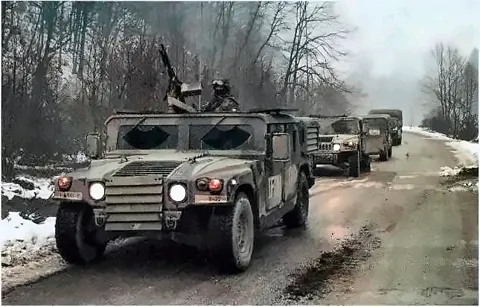
A convoy of Humvees proceeds through the Norwegian countryside during ‘Operation Cold Winter 87’, a NATO-sponsored military exercise. The lead vehicle is the M966 TOW missile carrier; the second vehicle is the M1036, identical in every way save for the inclusion of a front-mounted winch.
Photo: US Department of Defense · page 28 · p028-img01
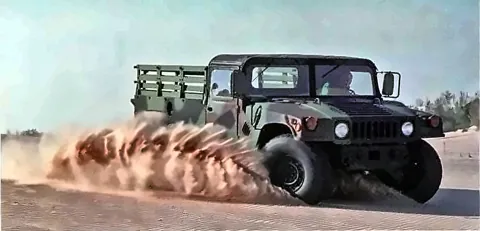
An M1097 heavy Humvee variant (HHV), in the two-door cargo/troop carrier role, shows what it can do in loose sand.
Photo: AM General · page 32 · p032-img01
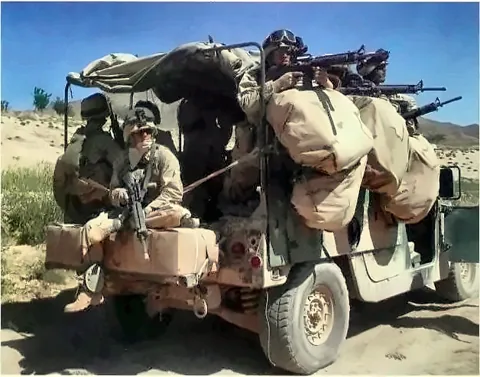
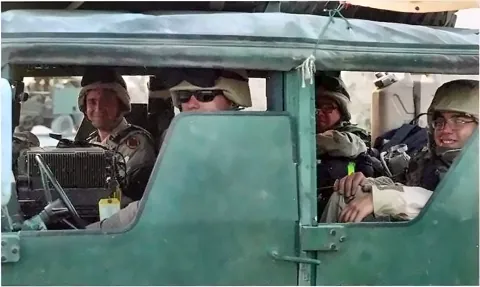
8 December 2003: US soldiers in an M998 cargo/troop carrier move out to search for former regime loyalists, foreign fighters and illegal weapons in Pir Ahmad, Iraq. The vehicle retains its Northern European camouflage scheme.
Photo: US Department of Defense · page 32 · p032-img02
Corporal Josh Parrish photographed at the wheel of an M998 cargo/troop carrier. The photograph was taken during ‘Exercise North Fuji Artillery Relocation 09-03’ at Camp Hansen, Okinawa. Note the M1037 shelter carrier behind.
Photo: Corporal John Chretien; US Department of Defense · page 32 · p032-img03
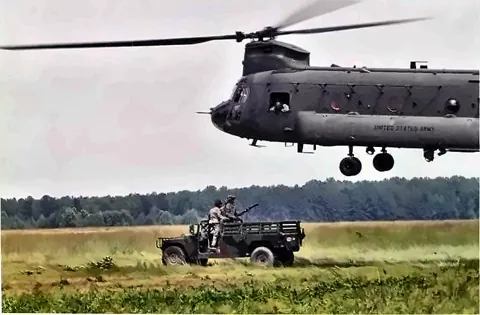
M1113 expanded capability Humvee (ECH) cargo/troop/shelter carrier being attached to a CH-47 Chinook helicopter at Fort Pickett, Virginia.
Photo: Sergeant Andrew H. Owen; US Department of Defense · page 32 · p032-img04
Introduced in 2005, the M1152 is described as an ‘expanded capacity enhanced IAP armour-ready cargo/troop carrier’. It can carry eight passengers or a 3,340–5,100lb (1,518–2,318kg) payload. Air conditioning equipment is fitted as standard, and optional ‘frag’ kits are available.
Photo: AM General · page 33 · p033-img01
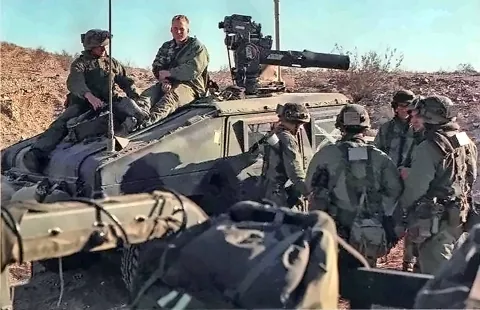
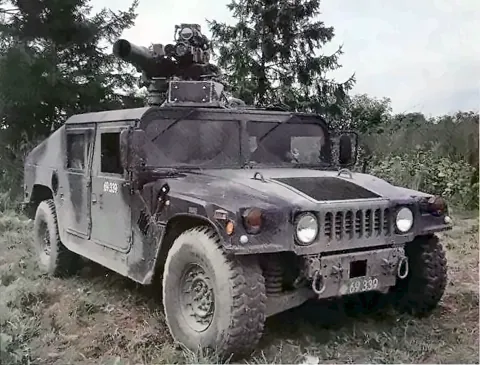
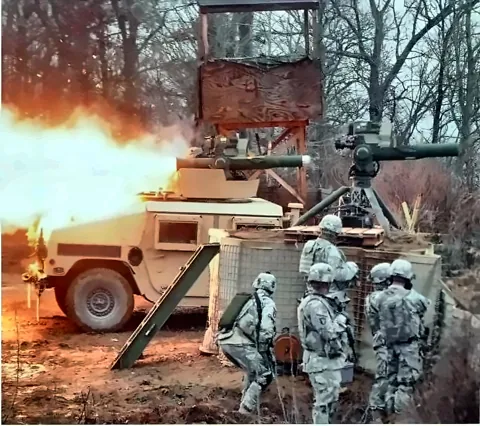
The M966 and M1036 variants, the latter differing only by virtue of its winch, are equipped to carry the Raytheon tube-launched, optically tracked, wire-guided (TOW) anti-tank missile system. The launch equipment is carried on the cab roof of the four-door slant-back body.
Photo: US Department of Defense · page 33 · p033-img02
M1045A2 of the Danish Army. Also equipped with the TOW missile launcher, the flat-panelled doors indicate that this variant carries the supplemental armour.
Photo: Carl Schulze · page 34 · p034-img01
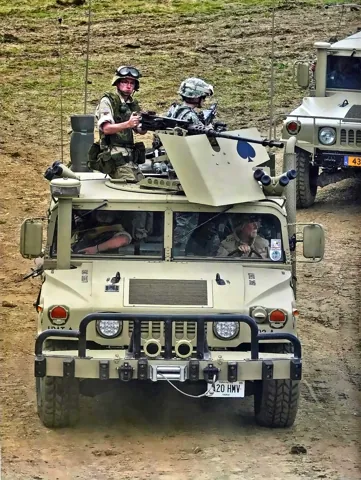
The lead vehicle is an M1026 armament carrier of the Luxembourg Army, whilst the second vehicle in the convoy is an M966 TOW missile carrier.
Photo: Carl Schulze · page 34 · p034-img02
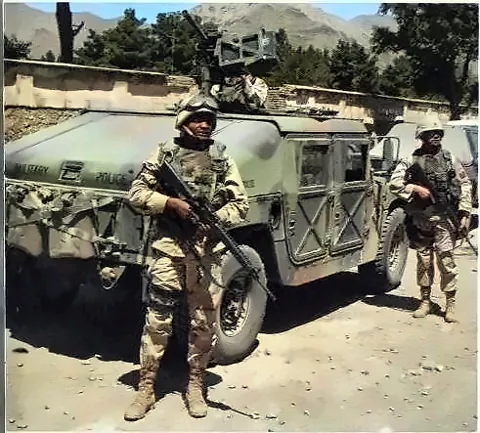
Assigned to the US Army’s military police, this M1025 armament carrier shows the distinctive appearance of the Kevlar-lined doors used on vehicles described as having ‘basic armour’.
Photo: US Department of Defense · page 35 · p035-img01
M1044A1, winch-equipped armament carrier of the Spanish Marines photographed during ‘Exercise Eole 1998’.
Photo: Carl Schule · page 35 · p035-img02
Factory-fresh armoured M1114 – the ‘expanded capacity, up-armoured armament carrier’. Note the distinctive extended snout of vehicles that are equipped with the turbocharged Optimizer 6500 engine.
Photo: AM General · page 35 · p035-img03
The M1151 is also described as an ‘expanded capacity armament carrier’, but in this case is IAP armour-ready. The vehicle is fitted with windscreen-deflector, under-body and sill (rocker panel) armour and energy-absorbing seats.
Photo: AM General · page 35 · p035-img04
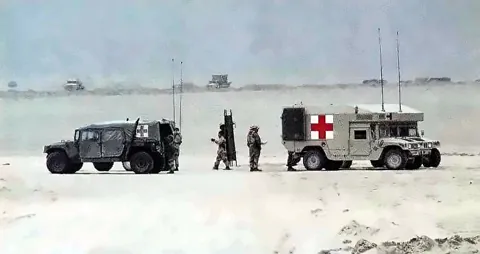
M997 maxi-ambulance with basic armour. The box-bodied ambulance can accommodate a combination of four stretcher patients or eight seated, and the clearance inside the rear body provides sufficient headroom to allow medical attendants to stand. Note the factory brush guard.
Photo: David Doyle · page 36 · p036-img01
The Marine Corps’ M1035 soft-top ambulance (left) is effectively a specialised version of the basic cargo/troop carrier, and is designed to accommodate a two-man crew and a combination of two stretchers or three seated patients. Contrast the height of the M1035 with the standard M997 ambulance alongside.
Photo: US Department of Defense · page 36 · p036-img02
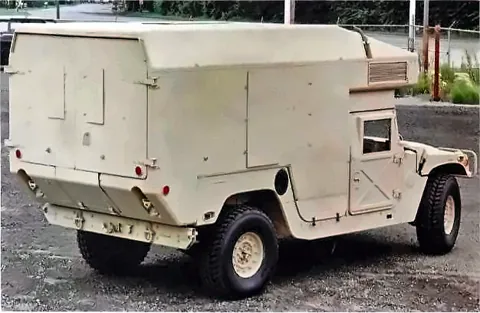
Rear view of the box-bodied M997 ambulance showing how the extended body is cut away at the rear to improve the departure angle. The same body was also offered as the basis of a C3I (command, control, communications, intelligence) vehicle.
Photo: AM General · page 36 · p036-img03
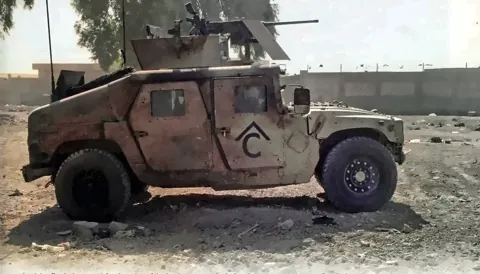
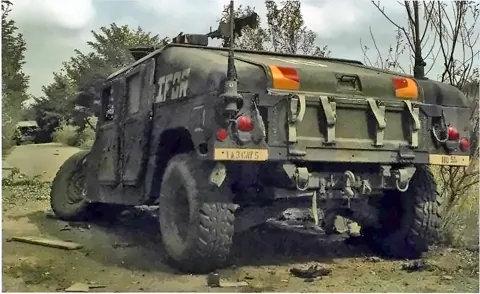
Here’s how a Humvee looks after a vehicle-borne IED (improvised explosive device) strike. The photograph was taken in Baghdad during ‘Operation Iraqi Freedom’ in 2005.
Photo: Specialist Preston E. Cheeks; US Department of Defense · page 37 · p037-img01
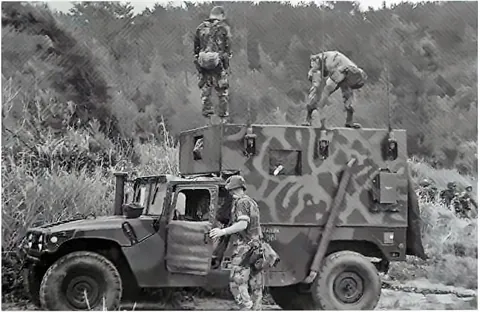
M1037 shelter carrier with soft doors. The vehicle is designed to carry an S250 or S788 standard EMI (electro-magnetic interference) hardened integrated command post shelter. Note the high-level exhaust outlet and air intake stack pipe.
Photo: US Department of Defense · page 37 · p037-img02
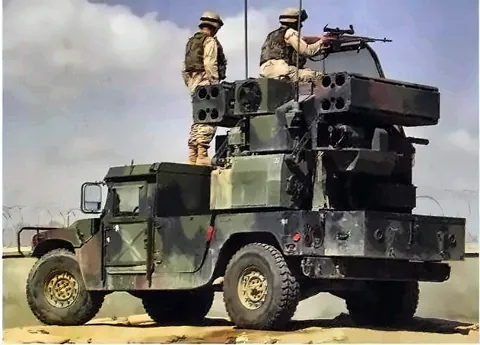
The M1037 shelter carrier was also used as the basis for the Avenger air-defence vehicle. A large electrically operated turret fitted into the load bed carried a pair of missile launch assemblies, each of which held four FIM-92 Stinger ground-to-air missiles. The cab roof was reinforced to provide a working platform.
Photo: US Department of Defense · page 38 · p038-img01
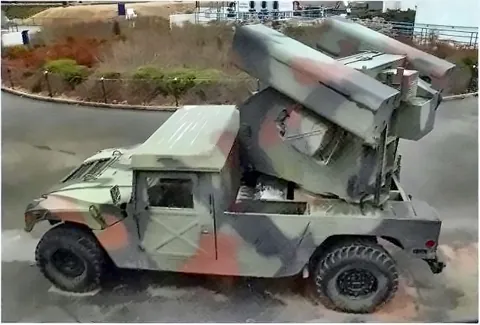
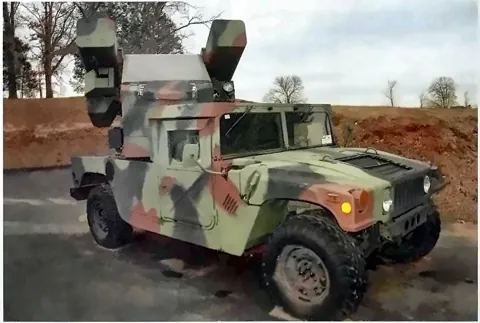
Overhead and frontal views of an Avenger air-defence vehicle at the US Space and Rocket Center at Huntsville, Alabama. Although deployed to Iraq during ‘Operation Desert Storm’ in 1991, a lack of targets meant that the weapon was not fired in anger.
Photo: David Doyle · page 38 · p038-img02
Overhead and frontal views of an Avenger air-defence vehicle at the US Space and Rocket Center at Huntsville, Alabama. Although deployed to Iraq during ‘Operation Desert Storm’ in 1991, a lack of targets meant that the weapon was not fired in anger.
Photo: David Doyle · page 38 · p038-img03
The M1069 two-door artillery prime mover is designed to tow the US Army’s M102 or M119 105mm light howitzer, and to provide transport for the gun crew.
Photo: AM General · page 39 · p039-img01
Typical of the expanded capacity up-armoured variants, the IAP-ready M1165 is described as a command and control/general purpose vehicle. It can also be equipped for the special operations role, as well as being available with a weapons mount and turret.
Photo: AM General · page 39 · p039-img02
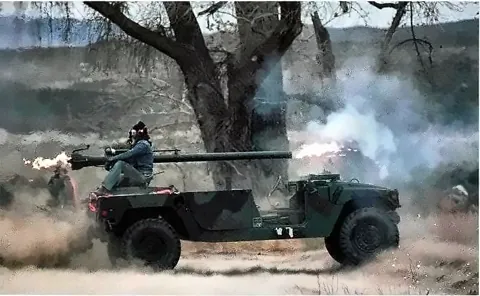
M998 cargo/troop carrier modified to carry an M40A2 106mm recoilless anti-tank rifle. Produced at Watervliet Arsenal, the weapon dates from the early 1950s and was deployed in both the Korean and Vietnam Wars. In US service, it was replaced by the BGM-71 TOW anti-tank missile system, although it remains in production in India and Iran.
Photo: AM General · page 40 · p040-img01
Based on the M998 or M1026, the special forces ground mobility vehicle (GMV) – often described as the DumVee (desert Humvee) – was produced by the US Special Operations Command (SOC). There were four variants, for use by the US Rangers, Special Operations Command, Naval Special Warfare Command and the Marine Corps.
Photo: US Department of Defense · page 41 · p041-img01
Ground mobility vehicle showing the under-body and sill (rocker) armour. Note the smoke launchers on the corners of the cab roof and the armoured front door; at the rear, the Kevlar-reinforced doors of the basic armour package have been retained.
Photo: Sergeant Keith D. Henning; US Department of Defense · page 41 · p041-img02
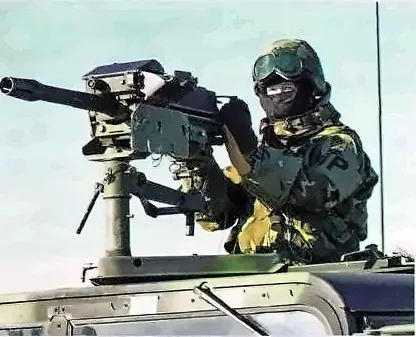
Bristling with weapons, including the Mk19 40mm automatic grenade launcher on the cab roof, the GMV-R is designed for use by the US Rangers. Some of these vehicles were deployed during the first Gulf War in 1991 and in Somalia in 1992–93; the design started to fall from favour in about 2009.
Photo: US Department of Defense · page 41 · p041-img03
Produced by Rock Island Arsenal, the US Marine Corps’ ‘shop equipment contact maintenance and repair’ truck carries basic spare parts, tools and equipment sufficient to permit roadside repairs.
Photo: US Department of Defense · page 42 · p042-img01
AM General developed this fire-fighting variant in 1989, but it was not adopted by the US Army. Years later, the Roscommon Equipment Center, in co-operation with Michigan’s Forest Fire Experiment Station, modified a surplus M998 to produce a lightweight off-road fire-fighting appliance for rural areas.
Photo: AM General · page 42 · p042-img02
US Army soldiers from 2nd Battalion, 6th Base Support Battalion, 2nd Brigade Combat Team, 3rd Infantry Division, pull security over the hoods of Humvees after discovering a suspected improvised explosive device during a training exercise. The lead vehicle is an M1025 armament carrier.
Photo: US Department of Defense · page 43 · p043-img01
In 1989 AM General modified an early prototype or pre-production M1025 armament carrier to provide protection against 7.62mm rounds; the same modification was also available for the M966 TOW missile carrier. The vehicle was offered for sale, with availability said to be 1990, but was not adopted by the US Army.
Photo: AM General · page 43 · p043-img02
M1043 armament carrier with supplemental armour consisting of armoured-steel external door linings, designed to stop ballistic fragments weighing up to 44 grains (0.10oz, 2.85g). The vehicles are attached to a US Army Mobile Security Detachment and were photographed during training at Miramar Naval Air Station, California, in 2007.
Photo: US Department of Defense · page 44 · p044-img01
Fitted with the Marine armour kit, which was designed to protect against small-arms fire and improvised explosive devices (IED), this Humvee was photographed in downtown Fallujah.
Photo: US Department of Defense · page 44 · p044-img02
M1109 heavy variant up-armoured armament carrier, the first Humvee to provide any real degree of armoured protection. In the photograph, US Army Private First Class Shaughn Ford from HHC, 506th Brigade Troops Battalion, 101st Division, provides security after the vehicle got bogged down in mud during a convoy patrol in the Zafaraniyah District of Iraq.
Photo: US Department of Defense · page 44 · p044-img03
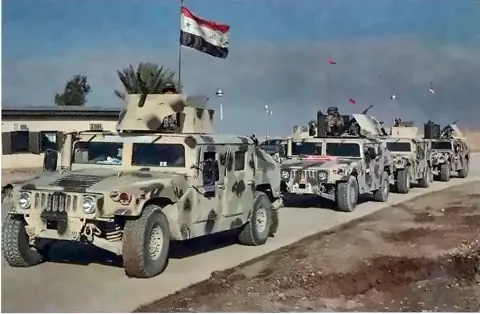
Iraqi Army soldiers await orders for a convoy before setting out for a city council meeting in Baghdad, Iraq, in January 2007. The vehicle is a winch-equipped M1114 armament carrier fitted with fragmentation kit 1 and the gunner shield and gunner protection kits.
Photo: Staff Sergeant Antoine T. Robinson; US Department of Defense · page 44 · p044-img04
The XM1124 hybrid electric Humvee used the M1113 chassis, but fitted with a hybrid electric driveline. The first prototype used a diesel engine and generator to drive four 75kW propulsion motors, one per wheel; in the second version just two motors were used, one per axle. The all-electric range was just six miles (10km).
Photo: Elizabeth Carnegie; TARDEC · page 45 · p045-img01
Prototyped in late 1990, the cab-over heavy Humvee variant (COHHV) used the maximum number of standard Humvee components necessary to offer a payload of 2.5 tons. Two prototypes and six pre-production machines were built, but there was no series production.
Photo: AM General · page 46 · p046-img01
Two examples of the Humvee-based Alvis Shadow were built in 2000 using a shortened and narrowed version of the Humvee M1113 ECV platform. Although it was offered to the British Army as a possible long-range reconnaissance vehicle, it was not adopted. One of the prototypes is in private hands.
Photo: Simon Thomson · page 47 · p047-img01
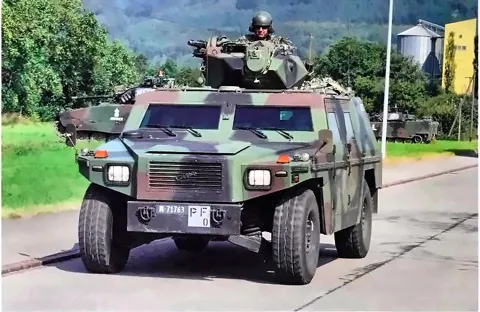
Based on the ‘heavy’ Humvee platform, the MOWAG Eagle is a relatively low-cost lightweight armoured reconnaissance vehicle for surveillance, escort, border patrol and police duties. This example, in service in Switzerland, was photographed during ‘Exercise Protector 2009’.
Photo: Carl Schulze · page 48 · p048-img01
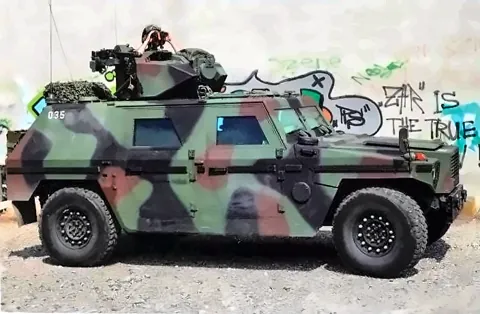
Side view of the MOWAG Eagle, showing the roof-mounted observation cupola. The armoured hull was designed and manufactured by MOWAG, and provides protection against 7.62mm ball ammunition at 33 yards (30m) and 7.62mm steel-core rounds at 110 yards (100m).
Photo: Carl Schulze · page 48 · p048-img02
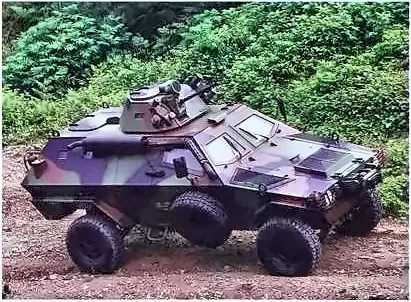
Constructed in Turkey by Otokar Otubüs Karoseri Sanayi using the Humvee expanded capability (ECV) chassis, the Cobra armoured platform provides the basis for a family of light armoured vehicles.
Photo: Otokar · page 48 · p048-img03
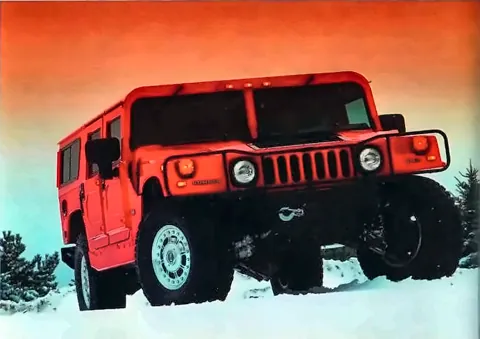
AM General finally made the Humvee available to the general public in 1992. Described as the Hummer – and latterly as the Hummer H1 – the launch range included a four-door station wagon, a two-door hardtop pickup truck, and a four-door pickup with either hard or soft top.
Photo: AM General · page 50 · p050-img01
There’s no disputing that the Hummer H1 has considerable presence but, with a launch price of $54,700 for the top-of-the-range model, it was never going to be a huge seller. By the time production ended in 2006, just 12,000 or so examples had been sold.
Photo: AM General · page 50 · p050-img02
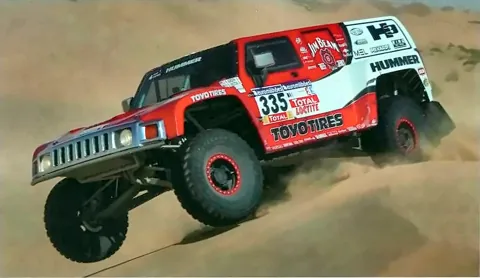
The Humvee was always considered to be a formidable off-road vehicle, and in 1993 Team Hummer Racing was created under the leadership of off-road racer Rod Hall, with some notable class wins in various events. In 2006 a highly modified, two-wheel-drive Hummer was raced by Robby Gordon in the Dakar Rally for the first time; the vehicle secured third place in 2009 and continues to compete in this event.
Photo: Maindru Photo · page 51 · p051-img01
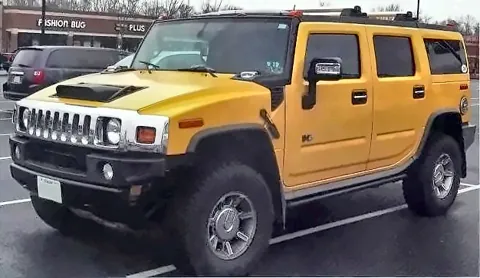
In 1999 AM General licensed production of the civilian Hummer to GM, and three years later a new civilian variant was launched under the brand name Hummer H2. Based on a heavily modified GMC 2500HD chassis, the new vehicle shared just a passing resemblance to the original military vehicle. Production of the H2 ended in 2009, by which time some 152,000 vehicles had been produced.
Photo: IFCAR · page 52 · p052-img01
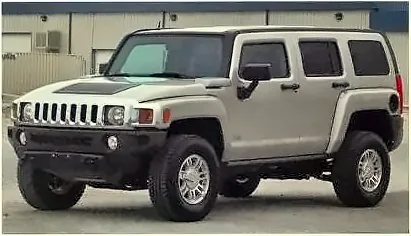
Described as a mid-sized sport utility vehicle (SUV), the Hummer H3 was launched by GM in 2005. Smaller in size than both the H1 and the H2, the H3 was powered by a five-cylinder engine driving all four wheels through a manual or automatic transmission. A pickup version, designated H3T, was launched in 2009.
Photo: NHTSA · page 52 · p052-img02
In August 2012, AM General launched the civilian Humvee C-Series kit. Looking for all the world like a military Humvee in civvy clothing, the C-Series consists of a fully assembled rolling chassis and body, a soft top and a painted body with a fully trimmed interior; the four-door body can be supplied in a choice of khaki, green or sand.
Photo: AM General · page 53 · p053-img01
Priced at $59,950 at the time of launch, the C-Series kit is supplied without engine and transmission. However, since these items are shared with the Chevrolet C/K pickup truck their acquisition should not present too much of a challenge.
Photo: AM General · page 53 · p053-img02
US Air Force personnel who are students in the Air Force Phoenix Warrior Training Course 07-4 drive in a convoy as part of class operations at the Naval Air Engineering Station in Lakehurst, New Jersey. The lead vehicle, which sports an interesting brush guard and a bridging plate on the engine cover, is an early production M1026 winch-equipped armament carrier.
Photo: US Department of Defense · page 54 · p054-img01
No caption in the book.
page 55 · p055-img01
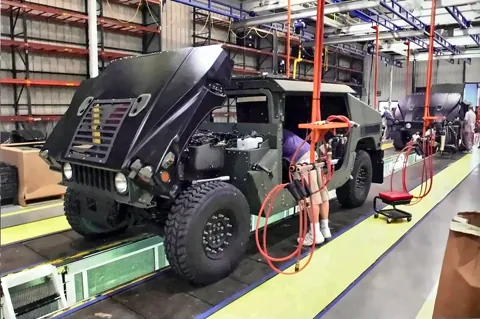
Fitting armour on the factory production line to an M1151 expanded capacity armament carrier.
Photo: AM General · page 56 · p056-img01
Aerial view of the AM General factory complex at Mishawaka, near South Bend, Indiana. Humvee production was moved to the new 550,000ft² (51,100m²) plant in 1990.
Photo: AM General · page 58 · p058-img01
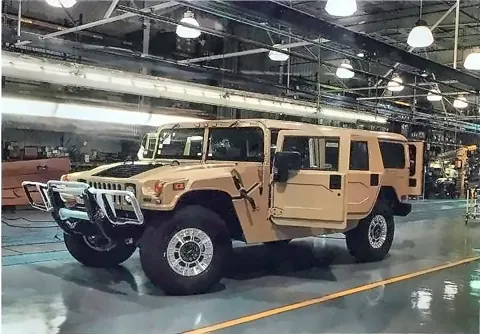
Production of the civilian Hummer H1 took place at the Mishawaka plant on the same production line. Following a 10-mile (16km) road run, the civilian vehicles were returned to a separate building for final painting and trimming.
Photo: AM General · page 59 · p059-img01
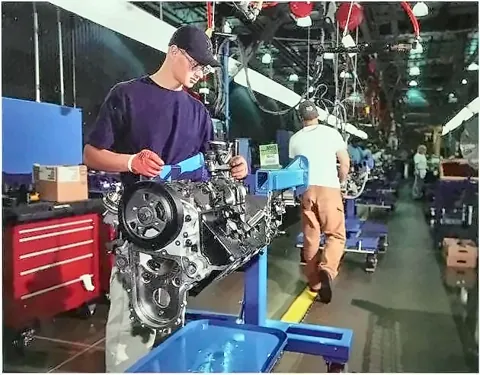
In 1999, AM General established General Engine Products (GEP) to produce the Optimizer 6500 V8 diesel engine at a 92,000ft² (8,583m²) plant in Franklin, Ohio. General Motors had previously constructed this engine at their Moraine Engine Plant, and, as part of the acquisition programme, provided technical support to assist AM General in developing the Franklin works.
Photo: AM General · page 60 · p060-img01
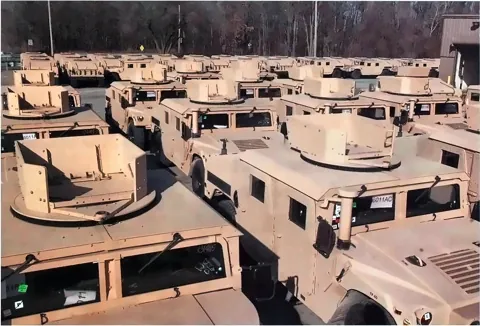
Brand new armoured M1151 variants parked at the factory awaiting shipment.
Photo: AM General · page 61 · p061-img01
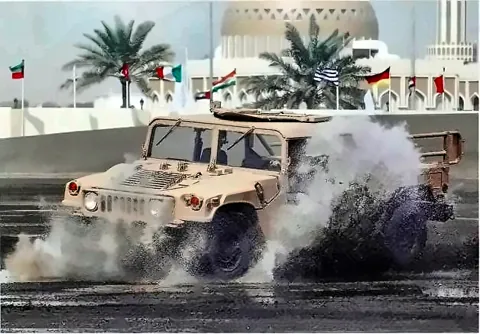
As part of the company’s export drive, Humvees are regularly shown at defence equipment exhibitions across the world. This armament carrier, equipped with a desert cooling package and central tyre-inflation system (CTIS), was photographed on a purpose-built demonstration track at IDEX in Abu Dhabi.
Photo: Simon Thomson · page 62 · p062-img01
Also seen at IDEX, this M1113 four-door cargo/troop/shelter carrier is being put through its paces in the demonstration area.
Photo: Simon Thomson · page 62 · p062-img02
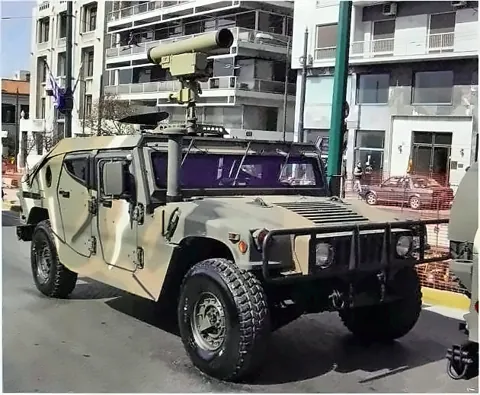
Humvees are manufactured in Greece by ELBO, with some 35 per cent local content. This TOW missile carrier is equipped with the Israeli Plasan armoured protection kit.
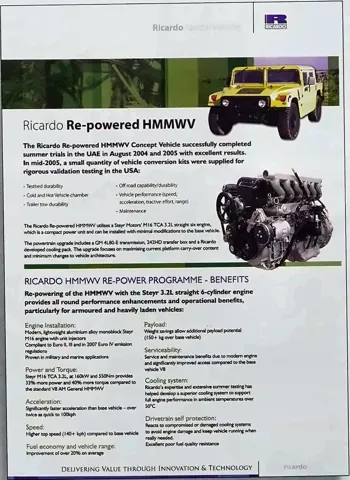
In 2004 a Steyr-powered concept vehicle was produced by the British-based engineering firm Ricardo, and successfully completed hot-weather trials in the United Arab Emirates. Driving through a GM four-speed automatic transmission, the engine was said to produce 33 per cent more power and 40 per cent more torque than the original GM V8.
Photo: Ricardo Engineering · page 64 · p064-img01
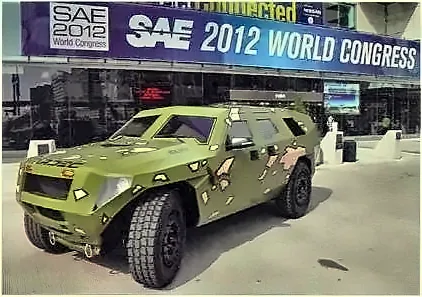
In 2012 Ricardo and TARDEC exhibited this Humvee-based hybrid-electric vehicle at the Society of Automotive Engineers World Congress in Detroit. Dubbed FED-Bravo, it featured a road-coupled parallel hybrid-drive system, with the front axle powered by an electric motor and the rear axle coupled to a hybrid fuel-powered/electric system.
Photo: Ricardo Engineering · page 65 · p065-img01
The Oshkosh TAK-4 heavy-duty independent suspension system for the Humvee is designed to counter the effects of blast from improvised explosive devices (IED). The system also has the additional benefit of increasing the usable payload when armour has been fitted, providing a better quality ride and improving braking by around 50 per cent.
Oshkosh demonstrated a TAK-4 modified Humvee at Quantico, Virginia, in 2010, and also offered the suspension to the US Marine Corps as part of a planned package of upgrades.
The distinctive press-moulded composite engine cover is manufactured by Saginaw Eagle-Pilcher Plastics, one of dozens of subcontractors to have contributed to the success of the Humvee.
Photo: Phil Royal · page 66 · p066-img01
No caption in the book.
page 67 · p067-img01
The M998 cargo/troop carrier, and the winch-equipped M1038 seen here, was always considered to be the base model of the Humvee family. Although shown here in four-door open format, soft or hard doors could be specified, or infill panels fitted into the rear door openings. Both high and low covers were produced for the cargo area.
Photo: David Doyle · page 68 · p068-img01
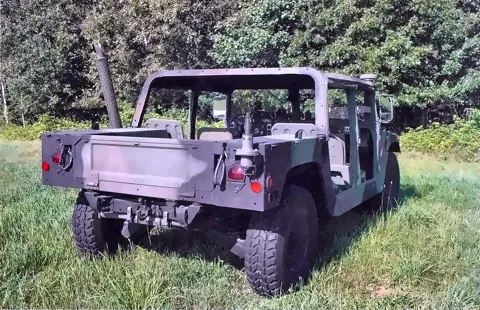
Rear three-quarter view of the M1038 cargo/troop carrier.
Photo: David Doyle · page 69 · p069-img01
The narrow chassis allows the body to straddle the main members, resulting in high ground clearance, but with a huge transmission tunnel. The members are swept up at the front to cradle the engine.
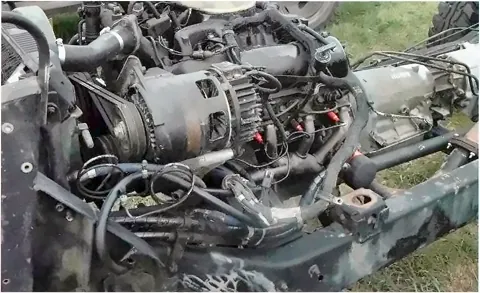
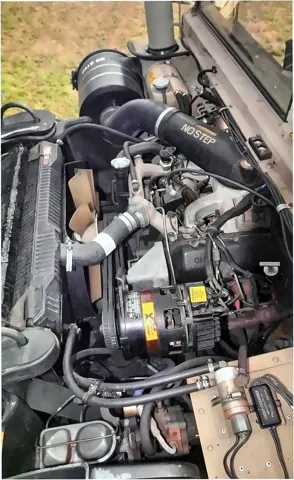
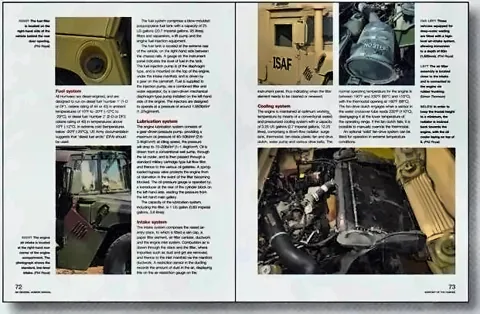
The engine is mounted at the front of the chassis, set back behind the front axle, and positioned at a slight angle to provide clearance for the front driveshaft. This allows the radiator to be set at an angle to reduce the height, but also results in the rearmost cylinders being virtually inaccessible.
Photo: Phil Royal · page 72 · p072-img01
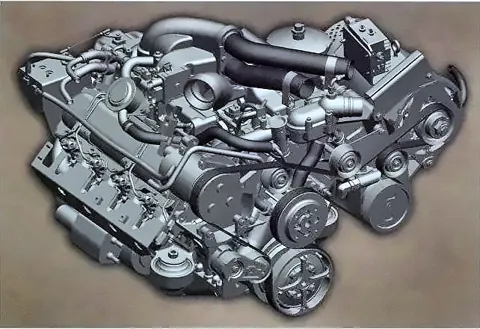
Computer-generated rendering of the Optimizer 6500 engine that replaced the original 6.2-litre unit, viewed from the front end.
Photo: AM General · page 73 · p073-img01
From 1995, the so-called ‘expanded capacity vehicle’ (ECV) was fitted with a redesigned, turbocharged version of the 6.5-litre engine. The design changes provide a 20–25 per cent increase in the tensile strength of the engine block.
Photo: David Doyle · page 73 · p073-img02
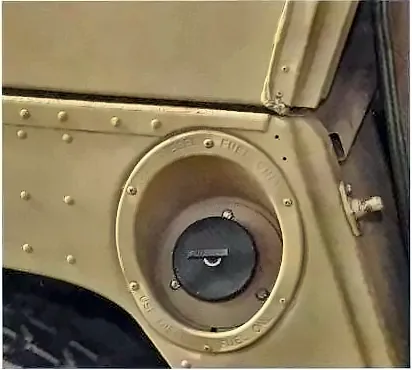
The fuel filler is located on the right-hand side of the vehicle behind the rear door opening.
Photo: Phil Royal · page 74 · p074-img01
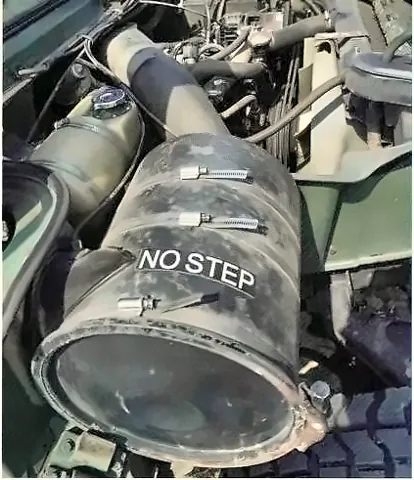
The engine air intake is located at the right-hand rear corner of the engine compartment. The photograph shows the standard, low-level intake.
Photo: Phil Royal · page 74 · p074-img02
Those vehicles equipped for deep-water wading are fitted with a high-level air-intake system, allowing immersion to a depth of 60in (1,525mm).
Photo: Phil Royal · page 75 · p075-img01
The air filter assembly is located close to the intake and is connected to the engine via rubber trunking.
Photo: Simon Thomson · page 75 · p075-img02
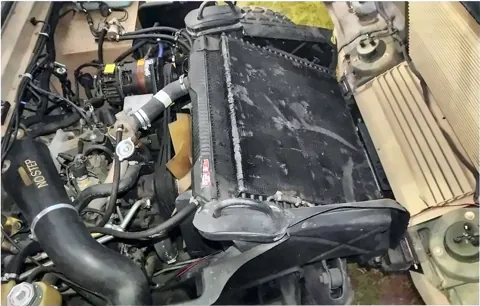
In order to keep the frontal height to a minimum, the radiator is inclined back towards the engine, with the oil cooler laying on top of it.
Photo: Phil Royal · page 75 · p075-img03
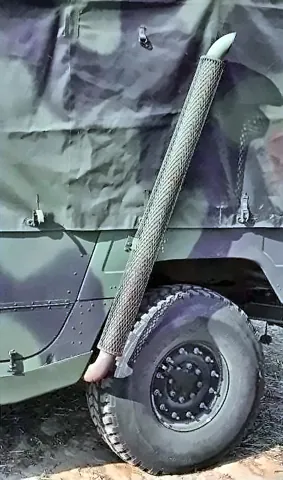
The standard exhaust system exits in front of the left-hand rear wheel, but an optional raised exhaust system is also available using a vertical extension to the pipe to allow deep-water wading.
Photo: Phil Royal · page 76 · p076-img01
The transmission is coupled directly to the rear of the engine by means of a three-element torque converter. The way that the body is designed to straddle the transmission results in this huge transmission tunnel.
Photo: David Doyle · page 76 · p076-img02
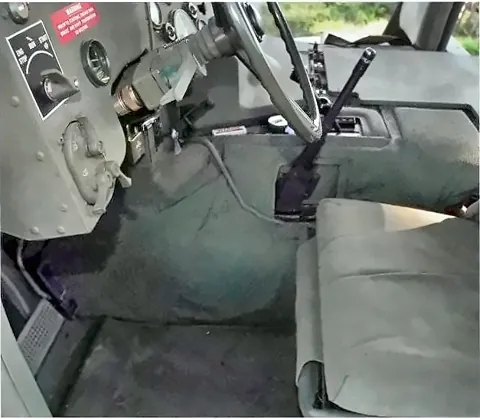
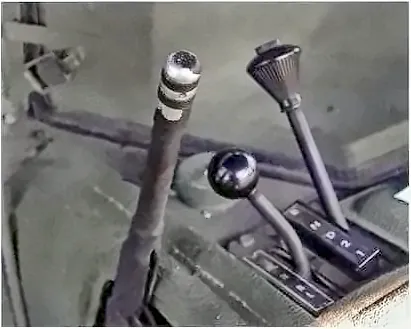
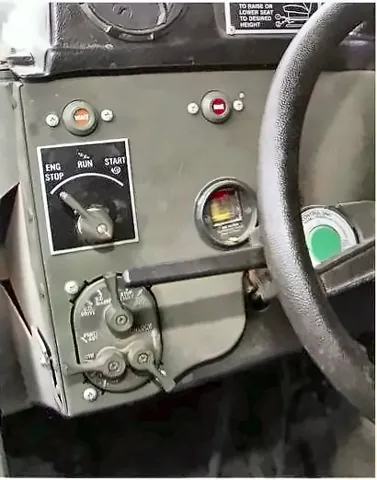
View of the shift lever for the main transmission, and the transfer-case selector lever. Note the lack of a ‘park’ position on the transmission selector, an identifying feature of the early THM-400 Turbo Hydra-Matic automatic gearbox.
Photo: David Doyle · page 76 · p076-img03
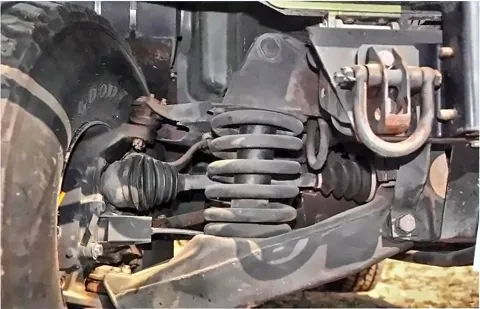
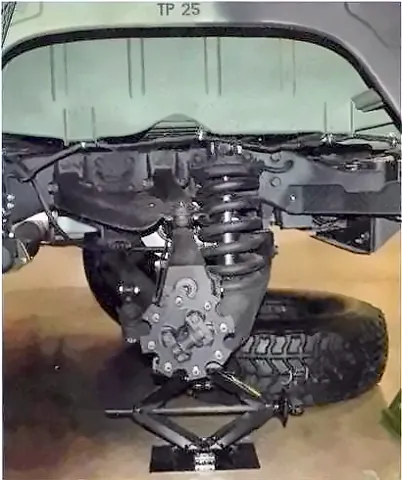
Under-chassis view showing the right-hand front suspension assembly and the driveshaft. The driveshaft enters the hub above the centreline of the wheel, with the power transferred via a reduction gear train.
Photo: Phil Royal · page 77 · p077-img01
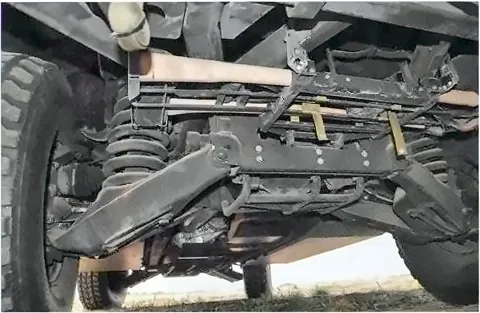
Under-chassis view from the rear showing the differential guard, suspension arrangements and driveshaft. It is also possible to see components of the pioneer kit that are stowed under the chassis at the rear.
Photo: Phil Royal · page 78 · p078-img01
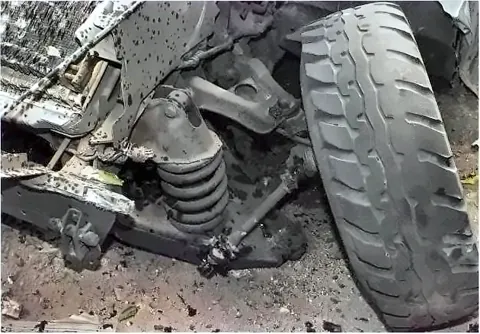
And this is what happens to the suspension when a Humvee drives over an anti-tank mine! Note how the driveshaft has been pulled out of the differential casing and the lower control arm joint has been destroyed.
Photo: US Department of Defense · page 78 · p078-img02
View of the rear hub and suspension arrangement with the wheel removed.
Photo: David Doyle · page 78 · p078-img03
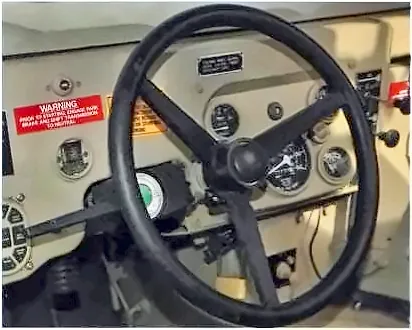
The inclusion of power-assisted steering as standard allows the use of a relatively small steering wheel – just 14in (355mm) in diameter.
Photo: Phil Royal · page 78 · p078-img04
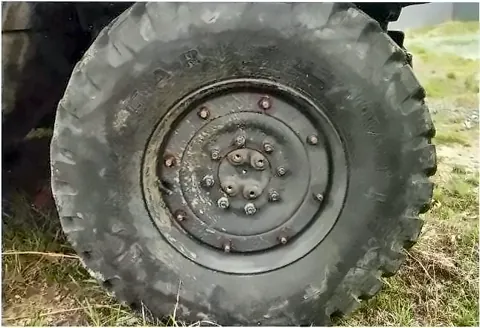
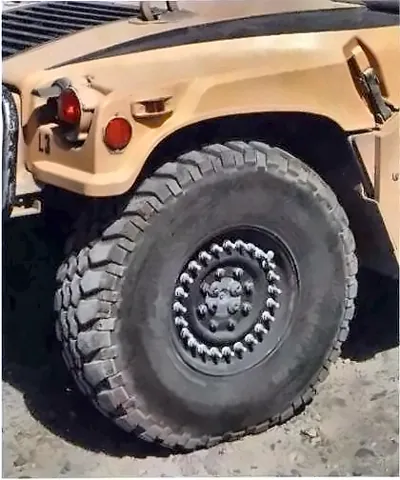
The Humvee rides on two-piece steel wheels, 16.5in (420mm) in diameter, wearing 37-12.5R 16.5in Goodyear Wrangler R/T-II bias-belted run-flat tyres. The wheels are secured to the hub by eight bolts, and the two parts of the original wheels were also bolted together using eight bolts.
Photo: Jeff Symanski · page 79 · p079-img01
Later wheels used 12 bolts to secure the two flanges, and were generally shod with Goodyear MT radial run-flat tyres.
Photo: Simon Thomson · page 79 · p079-img02
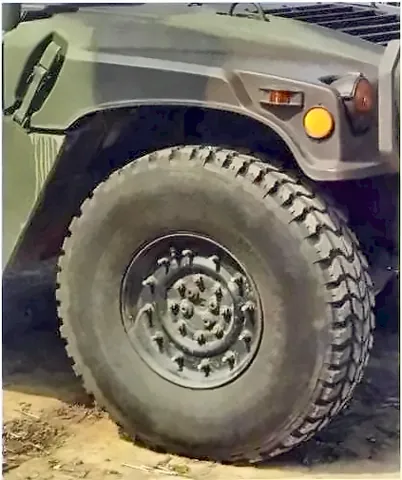
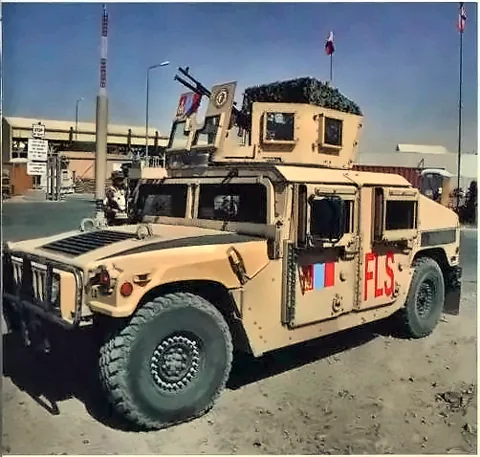
When the M1100 series was introduced, a change was made to 24-bolt wheels. The tyres on this Mongolian Army vehicle are B.F. Goodrich Baja T/A radial run-flats.
Photo: Carl Schulze · page 79 · p079-img03
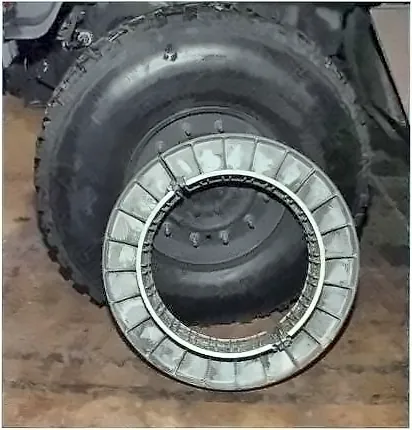
The original run-flat bead-lock insert was made from cast magnesium-alloy and allowed a vehicle to run on a deflated tyre for around 30 miles (50km). When the A2 upgrade appeared in 1995, rubber bead-lock inserts were adopted to provide greater mileage when running on deflated tyres.
Photo: Jim Alexander · page 80 · p080-img01
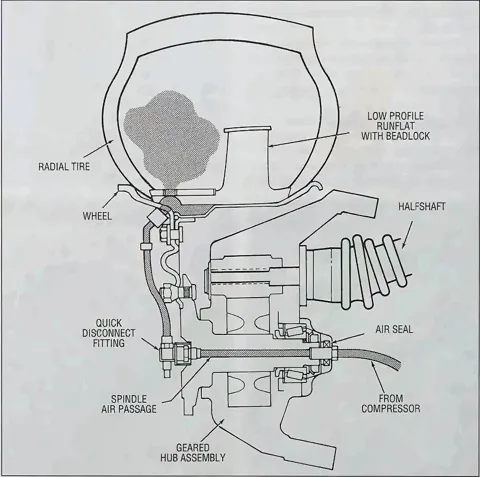
The central tyre-inflation system (CTIS) allows the driver to adjust the tyre pressures on the move, from inside the cab. An electric compressor provides the air supply, with a selector panel allowing either the front tyres, the rear tyres or all four tyres to be inflated or deflated.
Photo: AM General · page 80 · p080-img02
Vehicles fitted with the CTIS can be recognised by the small, flat protective guards fitted over the pipework that runs from the hub to the tyre valve.
Photo: Simon Thomson · page 81 · p081-img01
’A0’ and ‘A1’ variants that were fitted with a winch were identified using separate numbers; this practice was discontinued when the ‘A2’ upgrade was introduced, and the winch became an option. On early examples, the winch – which was manufactured by Warn – was electrically driven; on later models a hydraulic winch was used.
Photo: David Doyle · page 81 · p081-img02
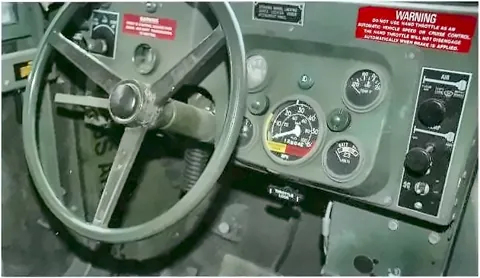
The instrument panel is a standard military unit and includes gauges for engine temperature, oil pressure, fuel level, battery voltage and vehicle speed; late models are also fitted with a rev counter (tachometer). A separate air restriction gauge indicates when the engine air cleaner needs attention.
Photo: Jeff Symanski · page 82 · p082-img01
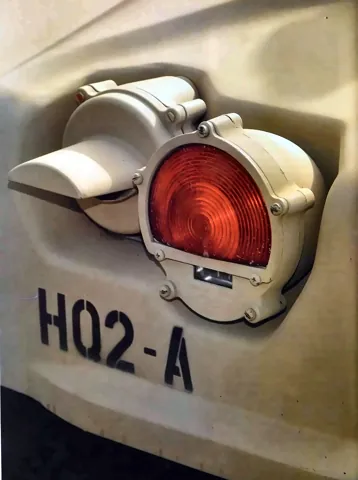
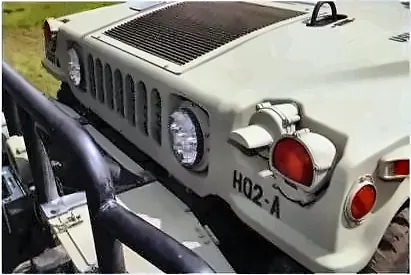
The front lighting arrangements include a pair of headlights, turn indicators (and side repeaters), blackout running lights and a blackout driving light. Reflective markers indicate the extremities of the vehicle.
Photo: Simon Thomson · page 82 · p082-img02
The original lighting switch used three interlocked rotary levers to select the various lighting options. This switch unit was also used in many other US military vehicles.
Photo: Jim Alexander · page 82 · p082-img03
At the rear there are running lights, indicators and side repeaters, brake lights and blackout running lights. Reflectors mark the rear and side of the vehicle.
Photo: US Department of Defense · page 82 · p082-img04
Later vehicles were fitted with a push-button lighting switch designed to fit into the same aperture. The turn indicator and hazard-warning switch can be seen to the right of the lighting switch.
Photo: Phil Royal · page 83 · p083-img01
Air-conditioning units have always been available as an option, but all of the M1114 up-armoured variants are fitted with air conditioning as standard in order to allow the enclosed vehicle to be operated in desert conditions. The grilles in the rear of the armoured slant back give the game away.
Photo: US Department of Defense · page 83 · p083-img02
All softskin Humvee variants share the same basic body configuration, with a full-width front-hinged composite engine cover, a scuttle and ‘A’ pillar assembly, which carries the folding/removable windscreen, and skeleton aluminium-alloy body panels. An integral hoop connects the ‘B’ pillars, whilst the windscreen frame is also sufficiently strong to act as a roll-over bar. Other body panels are fitted according to the vehicle’s role.
Photo: AM General · page 84 · p084-img01
On early examples, the air-inlet grille in the engine cover had eight slots, but from the ‘A1’ upgrade onwards this was modified to include more, and narrower, slots to provide additional cooling air; earlier vehicles were frequently upgraded with the new grille. The distinctive frontal appearance is partly down to the seven-slot radiator grille panel.
Photo: Phil Royal · page 84 · p084-img02
M1038 winch-equipped four-door cargo/troop carrier that has been fitted with Kevlar-protected doors and a hard roof panel. Note the low cover over the cargo bed.
Photo: Simon Thomson · page 84 · p084-img03
M998 cargo/troop carrier of the US Marine Corps. Operating with the US Navy as part of ‘landing force co-operation afloat readiness and training’, the vehicle is configured with four soft doors, and fitted with deep-water wading equipment.
Photo: US Department of Defense · page 84 · p084-img04
M998 cargo/troop carrier in two-door configuration, with soft doors and a high cover to the cargo area. The vehicle, which belongs to the 3rd Brigade, 2nd Infantry Division out of Fort Lewis, Washington, was photographed at the Port of Pusan in South Korea.
Photo: US Department of Defense · page 84 · p084-img05
M1097A2 heavy variant cargo/troop carrier with a hardtop cab and rear-door infill panels. Although the vehicle has the high-level air intake, it has not been fitted with the corresponding high-level exhaust system.
Photo: Simon Thomson · page 85 · p085-img01
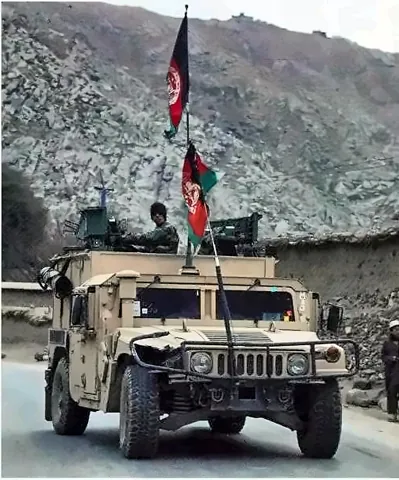
M1151A1 expanded capacity IAP-ready armament carrier of the Afghan Army fitted with the B1 kit and ‘frag kit 5’.
Photo: Carl Schulze · page 85 · p085-img02
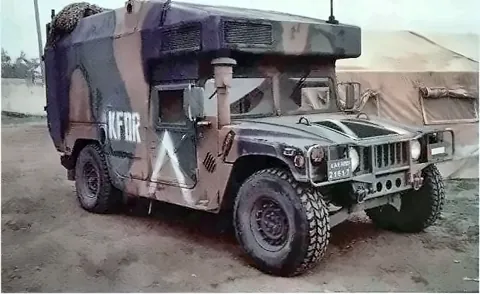
The box-body that provides the rear accommodation for the M997 maxi-ambulance can also be used in the so-called ‘C3I’ role (command, control, communications, intelligence), as in this United Arab Emirates vehicle photographed in Kosovo in 1999.
Photo: Carl Schulze · page 85 · p085-img03
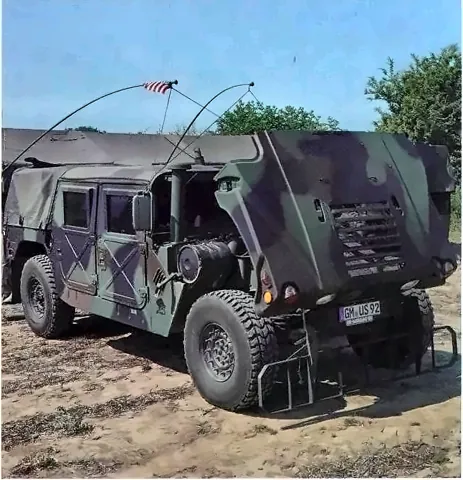
The one-piece press-moulded engine cover tilts forward to provide access to the engine. In the opened position the cover also prevents the vehicle being spotted by reflections from the windshield. Note how the brush guard is separately hinged.
Photo: Simon Thomson · page 85 · p085-img04
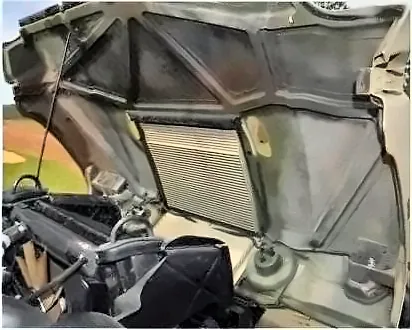
Inside view of the engine cover showing the reinforced twin-skin construction.
Photo: Phil Royal · page 86 · p086-img01
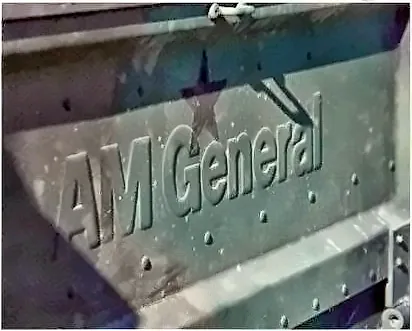
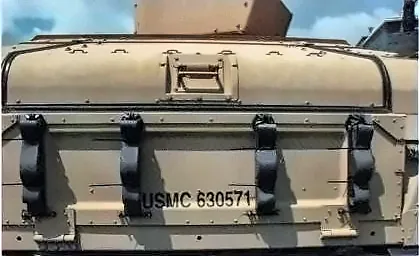
Early production vehicles featured the manufacturer’s name pressed into the tailgate.
Photo: Phil Royal · page 86 · p086-img02
Rear view showing the bottom-hinged tailgate. Being an ex-Marine Corps vehicle, this M998 does not have the rear bumpers.
Photo: David Doyle · page 86 · p086-img03
In the dropped-down position the tailgate is supported by stout chains and can be used as a load platform – clearly it can withstand considerable abuse!
Photo: US Department of Defense · page 86 · p086-img04
Additional footman loops can be attached to the tailgate to accept webbing straps. This vehicle was photographed during ‘Operation Ten Bears’ in Zafaraniyah, Baghdad, in January 2006. Note the extended rear cross-member onto which the towing pintle has been attached.
Photo: US Department of Defense · page 86 · p086-img05
Bagged camouflage netting stowed on the tailgate.
Photo: Jim Alexander · page 87 · p087-img01
The body of the maxi-ambulance is extended beyond the rear cross-member; the overhang provides space for a stowage locker and a set of fold-up steps.
Photo: David Doyle · page 87 · p087-img02
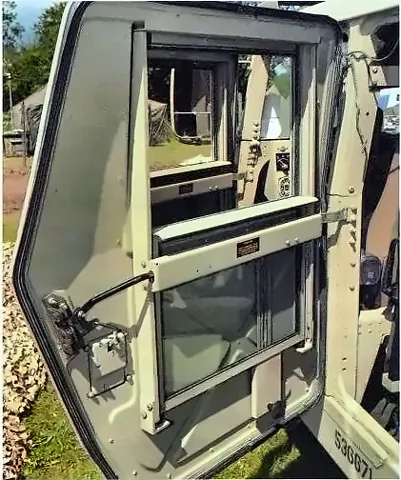
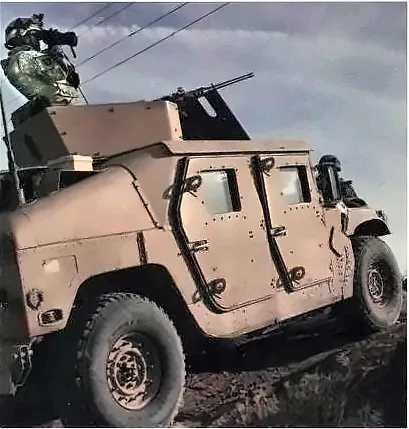
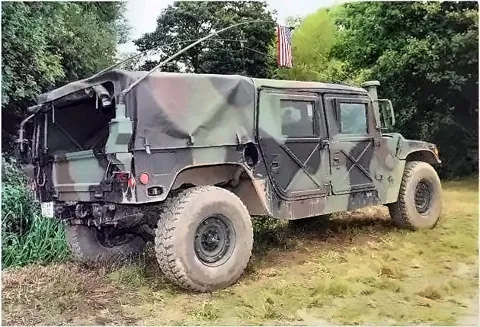
The Kevlar-reinforced doors fitted to vehicles described as having ‘basic armour’, in this case a winch-equipped M1026, can be identified by the cruciform moulded into the centre panel to provide rigidity. There are also vertically sliding polycarbonate glazing panels.
Photo: US Department of Defense · page 87 · p087-img03
Interior view of the Kevlar door showing the sliding glazing panel in the open position.
Photo: Simon Thomson · page 87 · p087-img04
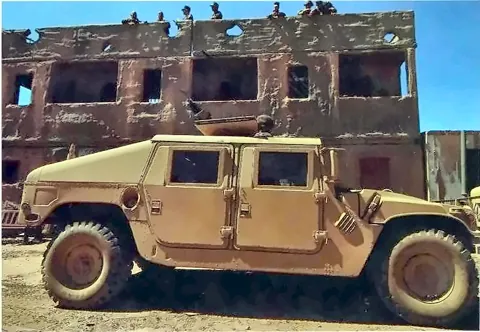
Early M1043 showing the doors that are fitted to vehicles equipped with the supplemental armour. Photographed at Miramar Naval Air Station, California, in 2007, the vehicle is taking part in a training exercise in a mocked-up Afghan village.
Photo: US Department of Defense · page 87 · p087-img05
Experience gained in the field in Afghanistan led to the use of welded rings on the armoured doors; these allowed blast-damaged doors to be ripped open using another vehicle, to rescue personnel who might be trapped inside.
Photo: US Department of Defense · page 88 · p088-img01
Cargo/troop carrier configured with four Kevlar doors and the low rear cover. Note the shovel (and other items of the pioneer kit) stowed under the chassis at the rear.
Photo: Simon Thomson · page 88 · p088-img02
Two-door winch-equipped M1097 heavy Humvee variant cargo/troop carrier with the high cargo-bay cover. The vehicle, which is towing a Silver Eagle light tactical trailer (LTT), belongs to the tactical imagery production system of 1st Marine Division’s combat camera and printing section.
Photo: US Department of Defense · page 88 · p088-img03
Privately-owned M997 cargo/troop carrier with a high cargo-bay cover and a stowage rack above the cab area.
Photo: Simon Thomson · page 88 · p088-img04
Standard Helmet glass-fibre composite hardtop as produced by Amtech Military Products; other patterns include a two-door crew-cab hardtop and two heights of cargo-bay cover. Custom covers are also available.
Photo: Simon Thomson · page 89 · p089-img01
M998 equipped with the standard Amtech Helmet hardtop, on which is mounted an STD-810 Stiletto screw-drive telescoping antenna mast.
Photo: US Department of Defense · page 89 · p089-img02
Short high-roofed custom-made hardtop mounted over the cargo bay in place of the standard rear hatch cover.
Photo: Simon Thomson · page 89 · p089-img03
Clips are provided inside the vehicle for the crew’s M16 rifles or M203 grenade launcher.
Photo: Jim Alexander · page 89 · p089-img04
Humvees do not routinely carry a spare wheel, but Ibis Tek manufactures a TACOM-approved rear-mounted swing-away spare-wheel carrier that incorporates a hand winch for handling the heavy wheel and tyre.
Photo: Ibis Tek · page 90 · p090-img01
The standard factory brush guard is designed to prevent damage to the glass-fibre engine cover. The guard must be dropped down to allow the engine cover to be opened.
Photo: Phil Royal · page 90 · p090-img02
Ibis Tek also manufactures this combined heavy-duty tubular-steel ‘pusher’ bumper and brush guard.
Photo: Simon Thomson · page 90 · p090-img03
Overhead view showing the roof hatch and weapons mount.
Photo: Jim Alexander · page 91 · p091-img01
Roof hatch in use, with the two-part hinged cover open.
Photo: US Department of Defense · page 91 · p091-img02
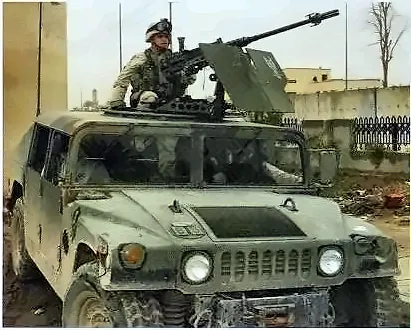
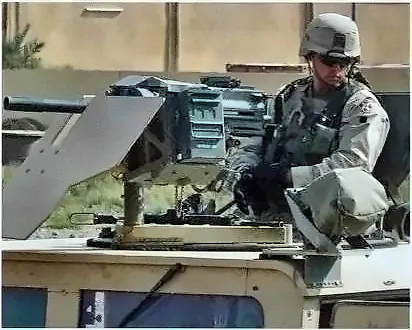
A pintle mount on the weapons ring can accommodate a variety of weapons: the vehicle nearest the camera has the M2HB 0.50in heavy machine gun, whilst the vehicle on the left mounts the Mk19 40mm grenade launcher.
Photo: US Department of Defense · page 91 · p091-img03
Private First Class Matthew J. Mongiove, from the 10th Mountain Division, provides security for the Canadian Mobile Training Team near the Pakistan border at Spin Boldak, Afghanistan. The gun is the M240 7.62mm general-purpose machine gun manufactured by the Belgian armaments company FN.
Photo: US Department of Defense · page 91 · p091-img04
Soldiers of the 9th Psychological Operations Battalion, 4th Psychological Operations Group, man a checkpoint on the outskirts of Tall Afar, Iraq. Additional protection is provided by the gunner shield kit.
Photo: US Department of Defense · page 92 · p092-img01
As well as being provided with overhead protection against artillery fragments, the up-armoured M1114 also included under-body protection for the crew compartment.
Photo: US Department of Defense · page 92 · p092-img02
The ‘objective gunner protection kit’ provides an armoured enclosure for the normally exposed gunner operating a weapon through the roof hatch.
Photo: US Department of Defense · page 92 · p092-img03
General interior view illustrating how relatively cramped the interior can become when filled with kit.
Photo: Phil Royal · page 93 · p093-img01
The size of the transmission tunnel results in a somewhat cramped driving position.
Photo: David Doyle · page 94 · p094-img01
The original seats were low-backed and offered little in the way of comfort or support.
Photo: David Doyle · page 94 · p094-img02
Typical northern hemisphere three-colour camouflage pattern using black and tan over a base coat of green. Note how the shade of the tan on the front door does not match that on the sill.
Photo: US Department of Defense · page 94 · p094-img03
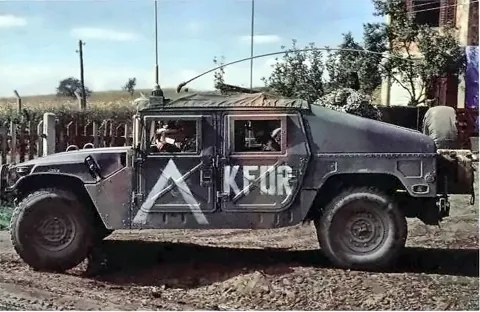
Humvee of the United Arab Emirates painted in the distinctive three-colour northern hemisphere camouflage pattern. The vehicle is assigned to the KFOR mission in Kosovo in 1999.
Photo: Carl Schulze · page 95 · p095-img01
From around 2004, in response to regular attacks on Coalition forces, the US Department of Defense started fitting armour to existing vehicles that were already deployed in Iraq. Interestingly, these green-painted Humvees have been fitted with sand-coloured doors and under-body protection components.
Photo: US Department of Defense · page 95 · p095-img02
Years of US involvement in the Middle East means that, like this up-armoured M1114, a large proportion of the US Army’s Humvee fleet has been painted sand. The photograph shows soldiers from 1st Battalion, 13th Armor Regiment, 3rd Brigade, 1st Armored Division, preparing to search buildings in Taji, Iraq.
Photo: US Department of Defense · page 95 · p095-img03
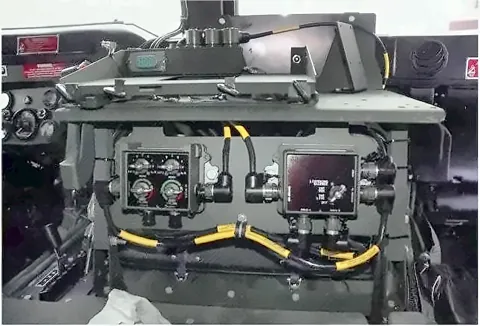
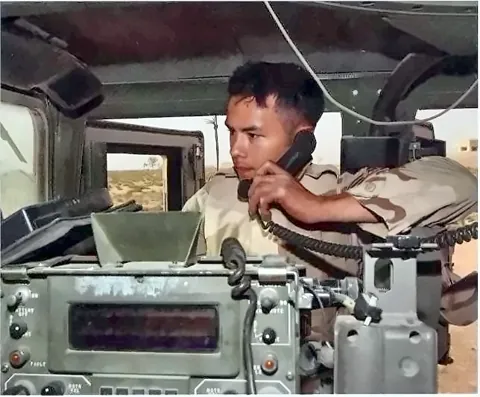
The width of the transmission tunnel provides plenty of space to mount radio and other communications equipment. This is the transceiver RT-524A/VRC, with inbuilt loudspeaker forming part of a typical AN/VRC-12 series radio station.
Photo: Phil Royal · page 96 · p096-img01
The radio antenna (AS 1729/VRC or AB-652/GR) and associated mounts are normally attached to the rear corners of the vehicle.
Photo: David Doyle · page 98 · p098-img01
This US Marines M998 has been fitted with expedient armoured sides and half-height armoured doors. Most noteworthy, however, is the field-fabricated stowage arrangement at the rear, designed to hold five standard fuel or water containers.
Photo: US Department of Defense · page 98 · p098-img02
Privately owned M1025 armament carrier equipped with a gunner shield kit, Ibis Tek heavy-duty pusher brush guard and front bumper, and rear-mounted spare-wheel carrier. The rear hatch can be configured to hinge from the top or the bottom.
Photo: Simon Thomson · page 99 · p099-img01
Winch-equipped M1026 armament carrier during a convoy operations class in March 2007, at a range on Fort Dix, New Jersey. The crew are US Air Force airmen of the Air Force Advanced Contingency Skills Training Course.
Photo: US Department of Defense · page 100 · p100-img01
No caption in the book.
page 101 · p101-img01
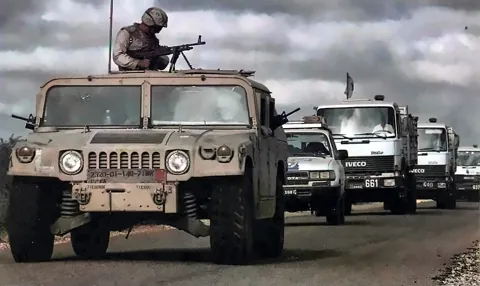
US Marines M1044 armament carrier with supplemental armour leading a convoy of white-painted UN vehicles on the road from Mogadishu to Biadoa in Somalia. The vehicle retains its stencilled plywood shipping tag.
Photo: US Department of Defense · page 102 · p102-img01
Men of the US Army 2nd Battalion, 8th Field Artillery, inspecting a weapons site in May 1989.
Photo: Staff Sergeant Lem Robson; US Department of Defense · page 102 · p102-img02
Standing beside an M1114 up-armoured armament carrier, soldiers from 1st Battalion, 198th Armor Regiment, 155th Brigade Combat Team, assist Iraqi police at a checkpoint in Najaf, April 2005. Note the field-expedient cylindrical armoured shield for the roof gunner.
Photo: US Department of Defense · page 103 · p103-img01
Based on the chassis of the M1097A2, the up-armoured M1114 started to enter service in 1996. Here, soldiers from the US Army A Battery 3rd Battalion, 320th Field Artillery Regiment, 101st Airborne Division, are preparing to convoy in Forward Operation Base Remagen, Iraq, April 2006.
Photo: US Department of Defense · page 103 · p103-img02
Using the wide, flat expanse of the Humvee engine cover as a table, US Army Captain Aaron Parker, Commander, Delta Company, Task Force 2nd Squadron, 11th Armor Cavalry Regiment, counts out 8.3 million Iraqi dinars (about $7,500) found on a suspected insurgent during a mounted patrol.
Photo: US Department of Defense · page 104 · p104-img01
Equally, the engine cover provides an excellent map table – here, US Air Force Technical Sergeant Jennifer Buckner checks the convoy route with fellow airmen during ‘Operation Northern Thunder’ at Camp Rilea in Warrenton, Oregon, June 2007.
Photo: US Department of Defense · page 104 · p104-img02
Private First Class Raymond Purtee, from the 561st Military Police Company, attached to the 10th Mountain Division, provides convoy security during a patrol near Bagram, Afghanistan, November 2006. The vehicle is a winch-equipped M1151A1 armament carrier.
Photo: US Department of Defense · page 104 · p104-img03
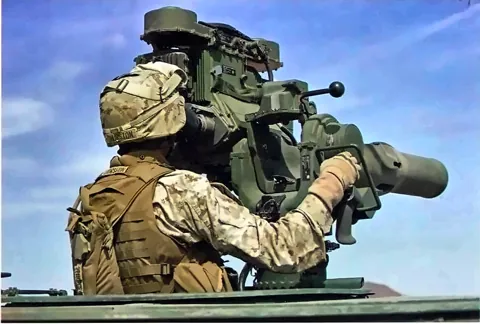
The TOW missile carrier is designed to mount a Raytheon tube-launched, optically tracked, wire-guided (TOW) anti-tank missile system designed for use against tanks and other armoured vehicles. Here, Private First Class Colin Hoffmeyer of the US Army 101st Airborne Division demonstrates the weapon at Fort Knox, Kentucky, in December 2011.
Photo: Sergeant Jon Heinrich; US Department of Defense · page 105 · p105-img01
Although now superseded by the more sophisticated TOW missile, the M40A1 106mm recoilless rifle nevertheless remains effective against lightly armoured targets. The weapon is commonly found mounted on a Jeep or Land Rover, but the M998 cargo/troop carrier Humvee is equally suitable.
Photo: AM General · page 106 · p106-img01
Leaning on his M2HB 0.50in heavy machine gun, a soldier of US Army Company C, 1st Battalion, 124th Infantry Regiment, guards the mayor’s office in Ar Ramadia, Iraq, January 2004. The vehicle is an open-sided M1025A2 armament carrier with field-expedient half doors.
Photo: Staff Sergeant Joseph Roberts; US Department of Defense · page 106 · p106-img02
A military policeman of the 4th Infantry Division’s 4th Military Police Company provides security from the turret of an up-armoured Humvee in October 2003. The weapon is a Mk19-3 40mm automatic grenade launcher.
Photo: US Department of Defense · page 106 · p106-img03
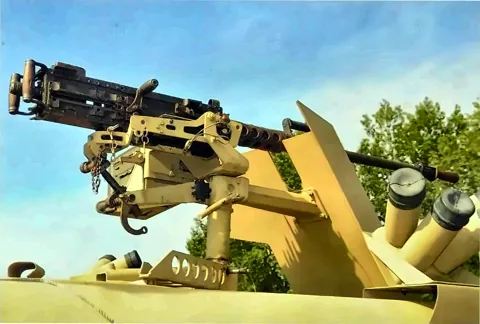
Close-up view of the M2HB 0.50in heavy machine gun in the pintle mount; the vehicle is also fitted with multi-barrelled smoke grenade launchers on the front corners of the roof.
Photo: Phil Royal · page 106 · p106-img04
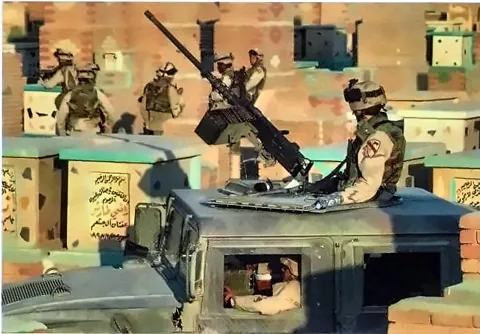
Soldiers of the US Army 1st Cavalry Division search the cemetery in An Najaf, Iraq, for weapons caches and insurgent fighters, August 2004. The vehicle, which mounts an M2HB 0.50in heavy machine gun, is an M1043 armament carrier with supplemental armour; an additional layer of Kevlar appliqué armour has also been attached to the doors.
Photo: US Department of Defense · page 107 · p107-img01
Mk19 40mm automatic belt-fed grenade launcher. Manufactured by Saco Defense Industries, this weapon first saw service in 1968, and has served through the Vietnam War, the various conflicts in the Middle East and into Afghanistan.
Photo: Master Sergeant Paul D. Charron; US Department of Defense · page 107 · p107-img02
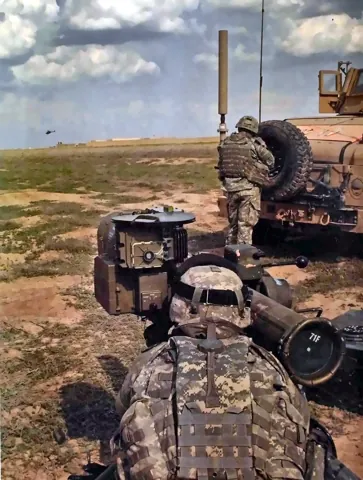
Close-up view of the TOW missile launcher mounted on the roof of an M1045. The photograph was taken at Stinger Range, Yuma, Arizona.
Photo: Sergeant Benjamin R. Reynolds; US Department of Defense · page 107 · p107-img03
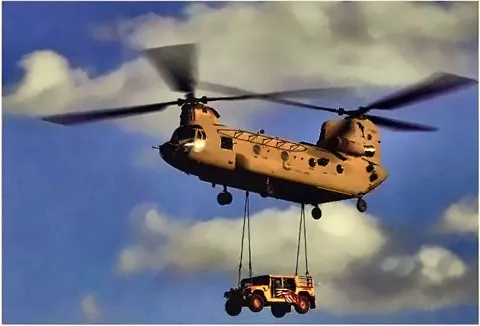
M998 cargo/troop carrier slung beneath a Boeing CH-47 Chinook helicopter. Photographed in South Afghanistan in 2010.
Photo: Senior Airman Kenny Holsten; US Department of Defense · page 108 · p108-img01
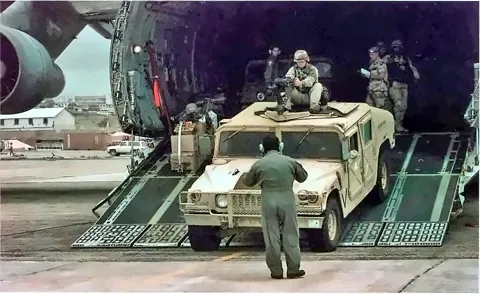
M1025 armament carrier being guided down the loading ramp of a Lockheed C-5B Galaxy cargo aircraft at Mogadishu Airport in 1993.
Photo: Sergeant M. Preston; US Department of Defense · page 108 · p108-img02
US Army 1st Lieutenant Keith Wolowodiuk of the 1st Battalion, 185th Infantry Regiment, 40th Infantry Division, California National Guard, gives convoy instructions prior to leaving for field training at Fort Dix, New Jersey, in July 2007.
Photo: US Department of Defense · page 109 · p109-img01
From about 1988 the US Army started replacing the AN/VRC-12 series with a new single-channel ground and airborne radio system (SINCGARS). The new equipment offers single-frequency and frequency-hopping capabilities both for voice and data transmission, and operates on any of the 2,320 channels between 30–88MHz.
Photo: David Doyle · page 109 · p109-img02
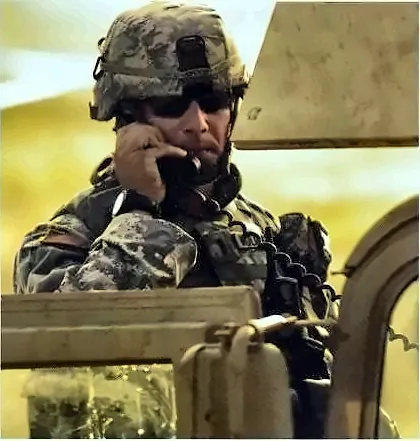
US Air Force Staff Sergeant Mitch Yang of 4th Air Support Operations Group communicates with an air-support aircraft during a convoy mission in northern Iraq.
Photo: US Department of Defense · page 109 · p109-img03
Front view of an M1038 with the half-finished shell of a mock Soviet BRDM-2 scout car being built around it. Described as VISMOD, the vehicle will be used by the 177th Armored Brigade in their role as an opposing force during exercises.
Photo: US Department of Defense · page 110 · p110-img01
A convoy of US soldiers, led by an up-armoured M1109, head towards Kladanj, Bosnia-Herzegovina, to attend a meeting between Bosnia-Herzegovina factions and Serbian forces to discuss clarification of the Zone of Separation.
Photo: US Department of Defense · page 111 · p111-img01
US Marine Corps personnel assigned to the Battalion Landing Team, 1st Battalion, 6th Marines, 22nd Marine Expeditionary Unit, Special Operations Capable (SOC), conduct a brief security halt while travelling in a convoy. The vehicle nearest the camera is an M1043 with supplemental armour.
Photo: US Department of Defense · page 111 · p111-img02
A convoy of M1114 up-armoured armament carriers photographed in the Ninewa province of Iraq. The vehicles belong to the US Army 3rd Armored Cavalry Regiment, 2nd Squadron (Saber), Lion Battery, normally based at Fort Carson, Colorado.
Photo: US Department of Defense · page 112 · p112-img01
A pair of M1097 heavy Humvee variants lead a US Marine Corps convoy on a dirt road towards Camp Lonestar, in Nginyang, Rift Valley Province, Kenya, in preparation to participate in ‘Exercise Natural Fire 2006’. This exercise is the largest conducted by US and East African community nations.
Photo: US Department of Defense · page 112 · p112-img02
Towing an elderly M101 or M116 series 0.75-ton two-wheeled trailer, a US Army M1165A1 participates in a battle rehearsal drill involving convoy security and improvised explosive device response. Both the Afghan Army and the Afghan police service were also involved. The location is Forward Operating Base Warrior, May 2007.
Photo: US Department of Defense · page 112 · p112-img03
The Humvee is capable of wading, unprepared, to a depth of 30in (762mm); with the deep-water wading kit fitted, the figure increases to 60in (1,524mm).
Photo: AM General · page 113 · p113-img01
One of the world’s most capable wheeled off-road vehicles, the Humvee is easy to drive on or off the road, and is fast, agile and stable in almost any situation.
Photo: AM General · page 113 · p113-img02
Military vehicles are built to withstand some degree of overloading, but the weight of the crew and passengers, combined with increasing amounts of makeshift armour, often proved too much for Humvees operating in Iraq and Afghanistan, leading to premature driveline and suspension failures.
Photo: US Department of Defense · page 114 · p114-img01
Introduced in 1992, and with the manufacturer’s loading figure quoted as 2.25 tons rather than the standard 1.25 tons, the M1097 heavy Humvee variant was the first attempt at providing an increased payload capability.
Photo: US Department of Defense · page 114 · p114-img02
Close-up of the severely damaged front end of an M1026 armament carrier that struck and detonated a Serbian TMA-1A anti-tank mine. The Kevlar basic armour would have offered very little protection in this situation, and the vehicle would almost certainly have been considered to be beyond economic repair.
Photo: US Department of Defense · page 115 · p115-img01
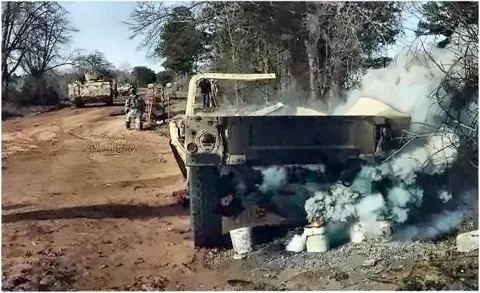
During a mission readiness exercise, smoke rises from a burning Humvee belonging to 1st Battalion, 30th Infantry Regiment, 3rd Infantry Division, that was hit with a simulated roadside bomb while on convoy during a mock cordon and search of the city of Al-Faraola created at Fort Stewart, Georgia.
Photo: Staff Sergeant Alfred Johnson; US Department of Defense · page 115 · p115-img02
These strange half-height armoured doors form part of a field-expedient armour upgrade kit used by the US Marines. The kit also includes large protective armoured panels for the sides of the cargo bay and for the engine cover.
Photo: US Department of Defense · page 116 · p116-img01
The vehicle already has the supplemental armour, but, no doubt well aware of its shortcomings, and in an attempt at increasing the level of protection, the Marine Corps crew have hung their personal body armour on the outside of the doors. Sandbags have also been stacked on the engine cover.
Photo: US Department of Defense · page 116 · p116-img02
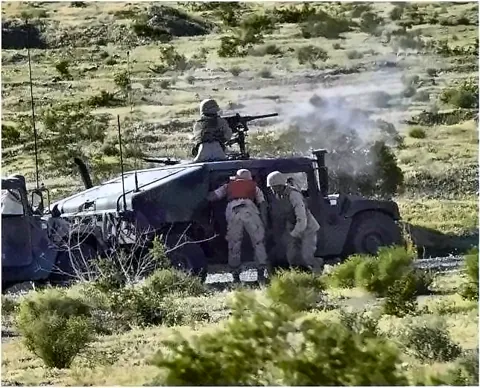
US Marine Corps personnel of 1st Platoon, Bravo Company, 1st Battalion, 7th Marine Regiment, arrive at their target objective during convoy operations training at the Marine Corps Air Ground Combat Center. The gunner is firing an M2HB 0.50in heavy machine gun from the roof of an M1043 armament carrier with supplemental armour.
Photo: US Department of Defense · page 117 · p117-img01
This M1038 cargo/troop carrier has been fitted with the supplemental armour doors and is being used by combat engineers to conduct a patrol in search of unexploded ordnance near the town of Bayji, Iraq, in June 2004. The soldiers are assigned to the 1st Infantry Division, 9th Engineer Battalion.
Photo: US Department of Defense · page 117 · p117-img02
Typical of the levels of protection required to operate in hostile environments, this expanded capacity IAP armour-ready M1152 is configured as a two-door pickup truck. The standard protection package includes under-body and sill (rocker panel) armour, a deflector at the lower edge of the windscreen, and energy-absorbing seats. Additional perimeter and overhead armour is available, as well as optional 'frag' kits.
Photo: AM General · page 118 · p118-img01
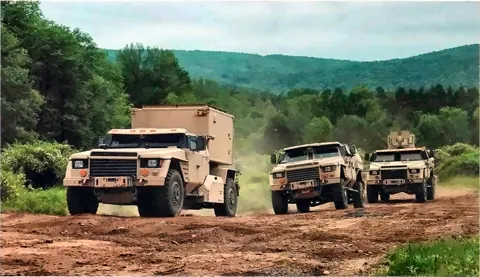
AM General and General Dynamics Land Systems have formed a joint venture named General Tactical Vehicles to compete for the US Army and Marine Corps joint light tactical vehicle (JLTV) programme.
Photo: AM General · page 119 · p119-img01
BAE Systems, together with partners Meritor Defense and Northrop Grumman, are also competing for the JLTV programme with their Valanx vehicle.
Photo: BAE Systems · page 119 · p119-img02
The third competitor for the JLTV programme is Lockheed Martin. In August 2013 a total of 22 vehicles were delivered to the US Army and Marine Corps for testing.
Photo: Lockheed Martin · page 120 · p120-img01
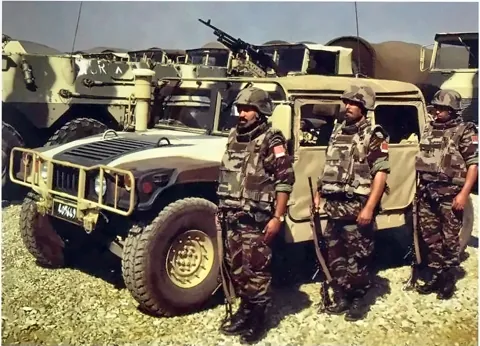
Moroccan Army M998A1 cargo/troop carrier forming part of the SFOR peacekeeping mission in Bosnia-Herzegovina in 1998.
Photo: Carl Schulze · page 121 · p121-img01
With all hatches and doors open, this Polish Army M1026 armament carrier sports a roof-mounted weapons station with the gunner shield kit.
Photo: Stefan Marx · page 121 · p121-img02
The same vehicle with the doors and hatches closed.
Photo: Stefan Marx · page 121 · p121-img03
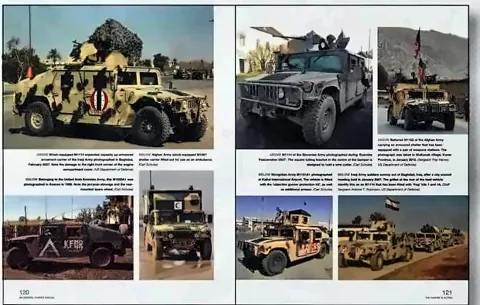
Winch-equipped M1114 expanded capacity up-armoured armament carrier of the Iraqi Army photographed in Baghdad, February 2007. Note the damage to the right front corner of the engine compartment cover.
Photo: US Department of Defense · page 122 · p122-img01
Afghan Army winch-equipped M1097 shelter carrier fitted out for use as an ambulance.
Photo: Carl Schulze · page 122 · p122-img02
Belonging to the United Arab Emirates Army, this M1025A1 was photographed in Kosovo in 1999. Note the jerrycan stowage and the rear-mounted spare wheel.
Photo: Carl Schulze · page 122 · p122-img03
M1114 of the Slovenian Army photographed during ‘Exercise Peacemaker 2007’. The square tubing bracket in the centre of the bumper is designed to hold a wire cutter.
Photo: Carl Schulze · page 123 · p123-img01
Battered M1152 of the Afghan Army carrying an armoured shelter that has been equipped with a pair of weapons stations. The photograph was taken in Mulkanah village, Kunar Province, in January 2012.
Photo: Sergeant Trey Harvey; US Department of Defense · page 123 · p123-img02
Mongolian Army M1151A1 photographed at Kabul International Airport. The vehicle is fitted with the ‘objective gunner protection kit’, as well as additional armour.
Photo: Carl Schulze · page 123 · p123-img03
Iraqi Army soldiers convoy out of Baghdad, Iraq, after a city council meeting held in January 2007. The grilles at the rear of the lead vehicle identify this as an M1114 that has been fitted with ‘frag’ kits 1 and 1A.
Photo: Staff Sergeant Antoine T. Robinson; US Department of Defense · page 123 · p123-img04
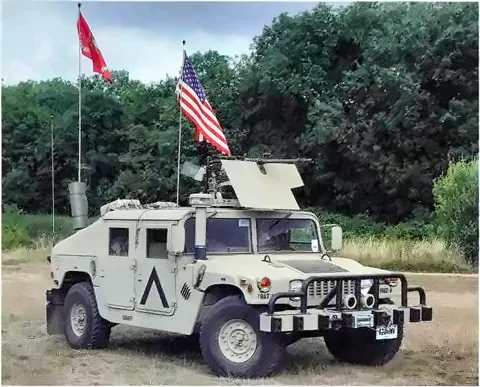
Outside of the USA, you would be very lucky to spot more than one Humvee at a military vehicle show ... the exception, of course, being the massive annual 'War & Peace Revival' event.
Photo: Phil Royal · page 124 · p124-img01
Outside of the USA, you would be very lucky to spot more than one Humvee at a military vehicle show ... the exception, of course, being the massive annual 'War & Peace Revival' event.
Photo: Phil Royal · page 125 · p125-img01
Formerly the property of the US Marine Corps, this M1044, with supplemental armour, sports a weapons station with the gunner shield kit, high-level air intake and exhaust systems and a front-mounted winch.
Photo: Jim Alexander · page 126 · p126-img01
Mounting dummy H2B 0.50in heavy machine guns, this pair of ex-Marine Corps M1026 armaments carriers were photographed in the ‘War & Peace’ arena in 2012. The lead vehicle also has the high-level air intake that allows deep-water wading.
Photo: Phil Royal · page 126 · p126-img02
Seen at the Virginia Museum of Military Vehicles, this M1025 armament carrier presents an almost factory-fresh appearance. Like most ex-Marine Corps vehicles it sports the high-level air intake.
Photo: David Doyle · page 127 · p127-img01
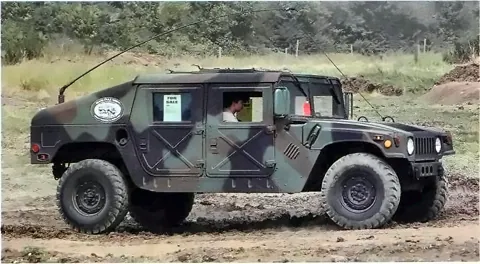
The strict rules governing disposal of used Humvees ensure that very few come up for sale on the collectors’ market. This M1025 was spotted carrying a ‘for sale’ sign at a military vehicle show – but you need to be quick and have deep pockets.
Photo: Simon Thomson · page 127 · p127-img02
The US Army does not currently sell used Humvees to the public, even when beyond economic repair. The situation may change when deliveries of the JLTV start in 2015, but at present there is no indication that this is the case.
Photo: US Department of Defense · page 128 · p128-img01
Very tidy privately owned ex-Marine Corps M1043 that has been fitted with the Ibis Tek reinforced pusher bumper, high-level air intake, and weapons station with gunner shield kit. Note also the bumper-mounted infrared lights.
Photo: Simon Thomson · page 129 · p129-img01
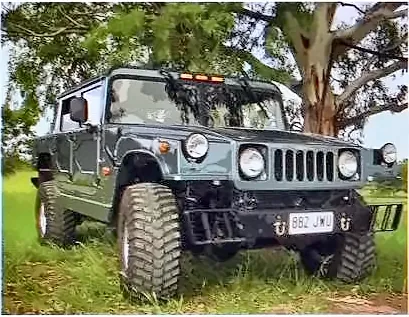
The lack of availability of Humvees on the civilian market and the relatively high price of those vehicles that are available has led to the appearance of a number of replicas and lookalikes. This is the Australian-built Rhino Buggy Hammer H1 (www.rhinobuggies.au.com), priced from around $15,000 (Aus) in kit form.
Photo: Rhino Buggies · page 130 · p130-img01
Being pretty much unstoppable, driving a Humvee off the road can be an exhilarating experience ... always provided, that is, that you are not actually being shot at!
Photographed on a New York street in 1989, this M998 is configured as a two-door pickup with a high rear cover. The sheer width of the thing means it is probably less at home in the somewhat narrower streets found in Britain.
Having one wheel off the road, even when climbing, presents little difficulty... the combination of torque-biasing differentials, plus a centre differential, allows the vehicle to lose traction at three wheels without becoming immobilised.
Photo: AM General · page 131 · p131-img03
Whilst occupants may have complained to AM General that the interior is not entirely waterproof, the automotive components fare considerably better. Even without the deep-water wading kit, the electrical and intake systems are sufficiently protected to allow the Humvee to wade to a depth of 30in (762mm).
Photo: AM General · page 132 · p132-img01
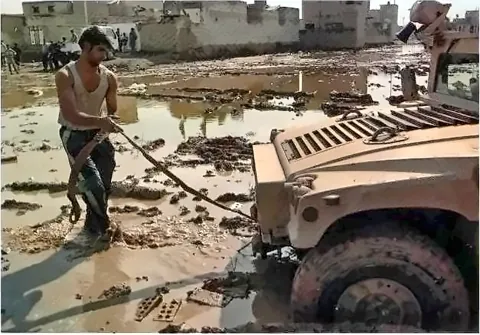
Despite the use of torque-biasing differentials, if all four wheels lose traction forward motion will cease and it will be necessary to find a tow.
Photo: US Department of Defense · page 132 · p132-img02
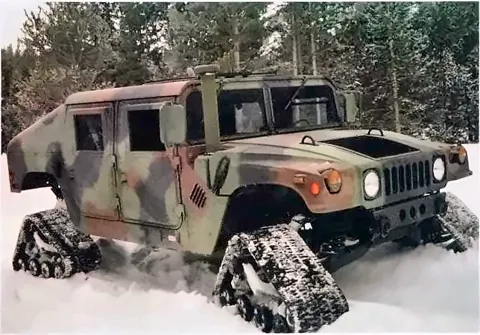
This M1043 has been equipped with snow tracks at each wheel station which, although doing little for the steering and handling characteristics, certainly give the vehicle an edge in deep snow.
Photo: Lance Corporal E.J. Young; US Department of Defense · page 133 · p133-img01
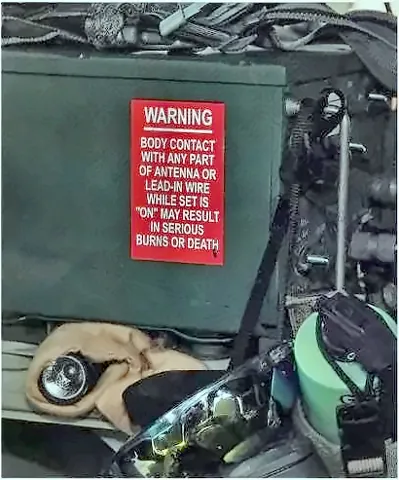
Soldiering is a hazardous enough business at the best of times, without inviting avoidable injury... which might explain why the Humvee, like all modern military vehicles, carries every conceivable kind of warning.
Photo: Simon Thomson · page 134 · p134-img01
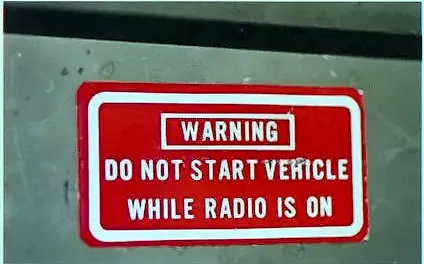
Even starting the engine whilst operating the radio is considered to be a hazard.
Photo: Jim Alexander · page 135 · p135-img01
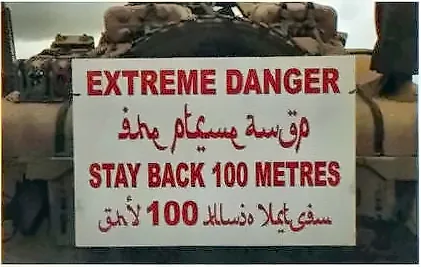
In Iraq and Afghanistan it is also necessary to issue warnings to civilians – approaching too close is presumably interpreted as a hostile act in an environment where the good guys and the bad guys are often indistinguishable.
Photo: Simon Thomson · page 135 · p135-img02
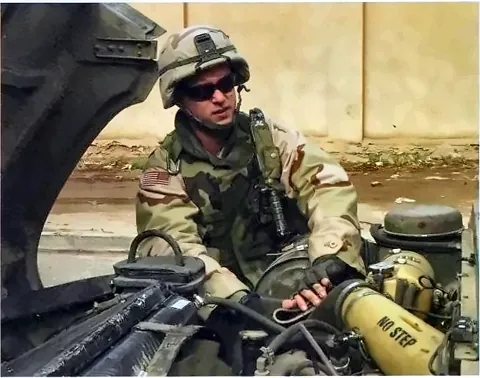
For the military, roadside breakdowns can be hazardous. For the civilian, in a privately owned vehicle, a breakdown is, at best, inconvenient. Here, a US soldier makes emergency repairs to his Humvee during a civil affairs mission in Baghdad, Iraq.
Photo: US Department of Defense · page 135 · p135-img03
Where mere seconds can make the difference between life and death, it makes sense to have a tow rope ready for use should a breakdown occur.
Photo: US Department of Defense · page 136 · p136-img01
Towing a vehicle with an automatic gearbox normally requires the drive to the wheels to be disconnected... the Humvee has a neutral position in the transfer case to allow a disabled vehicle to be towed without further mechanical attention.
Photo: US Department of Defense · page 136 · p136-img02
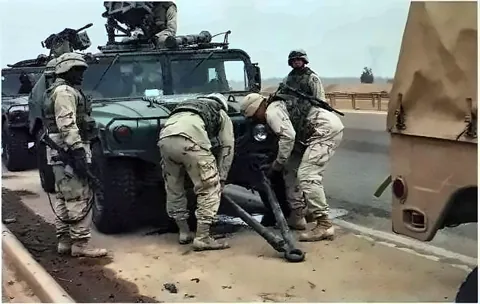
If you are in the fortunate position of owning two Humvees, then, should the worst happen, you can always use one to push the other! Here US Army personnel push an immobile vehicle to safety on a convoy retrieval exercise at Memorial Range, Tikrit, Iraq.
Photo: Jeremiah Green; US Department of Defense · page 136 · p136-img03
Personnel of the US Army, 2nd Armored Cavalry Regiment, based at Fort Pope, Louisiana, maintain a defensive posture around their convoy, as a fellow soldier climbs into the engine compartment to make emergency repairs to an M1026.
Photo: US Department of Defense · page 136 · p136-img04
Although features such as power steering and automatic transmission make the Humvee easy to drive, the US Army nevertheless takes driver training very seriously. Here, students in the Air Force Advanced Contingency Skills Training Course prepare to move out as part of a convoy operations class at Fort Dix, New Jersey, 2007.
Photo: US Department of Defense · page 137 · p137-img01
Equally at home on or off the road, the Humvee can take rocks, loose soil, sand and water in its stride. Whilst pointing out that 'your grandmother could easily drive the thing to the supermarket', AM General's Craig MacNab also pointed out that 'it's an unbelievable off-road machine'.
Photo: AM General · page 137 · p137-img02
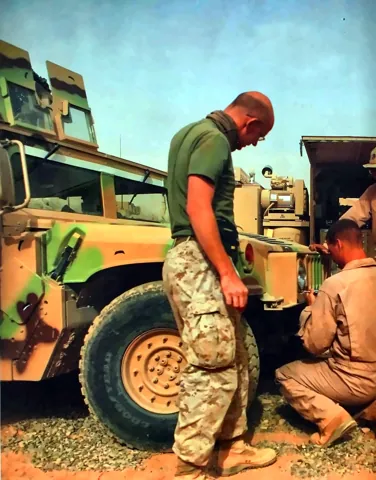
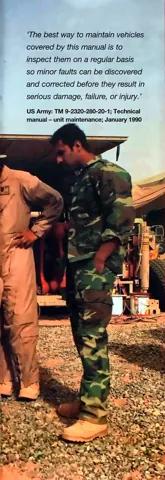
US Marine Corps Lance Corporal Stephen G. Stryburg, kneeling, a mechanic with Combat Logistics Company (CLC) 19, shows Iraqi soldiers how to perform routine preventive maintenance checks and service on a Humvee.
Photo: Sergeant Jason W. Fudge; US Department of Defense · page 138 · p138-img01
US Marine Corps Lance Corporal Stephen G. Stryburg, kneeling, a mechanic with Combat Logistics Company (CLC) 19, shows Iraqi soldiers how to perform routine preventive maintenance checks and service on a Humvee.
Photo: Sergeant Jason W. Fudge; US Department of Defense · page 139 · p139-img01
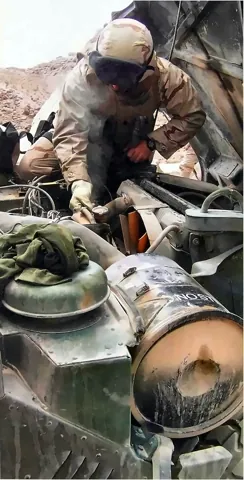
US Marine Corps Corporal Justin Loper, 22nd Marine Expeditionary Unit, examines an overheated Humvee engine during a brief convoy halt. If parts are required to effect a repair, help should never be far away.
Photo: US Department of Defense · page 140 · p140-img01
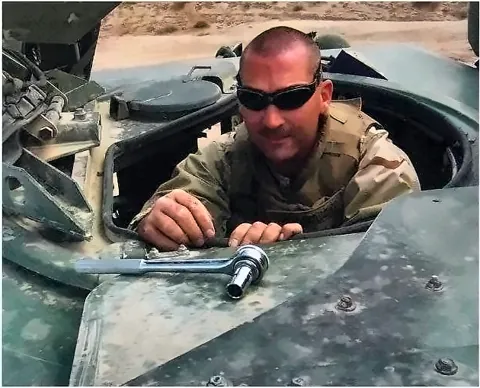
Breakdowns during convoy operation are a fact of life. If the problem is not sufficiently serious to bring the vehicle to an immediate halt, then repairs can be conducted when the convoy halts for a break. Here, US Marine Corps Gunnery Sergeant Sean McDonough makes repairs to a Humvee gun-mount ring.
Photo: US Department of Defense · page 142 · p142-img01
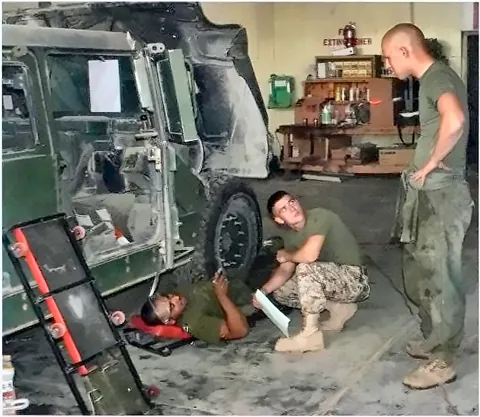
Of course, workshop facilities make life considerably easier for the vehicle mechanic, and the photograph shows marines from Maintenance Platoon, Headquarters Battery, 1st Battalion, 12th Marine Regiment, Task Force Military Police, working on a disabled Humvee at the 1/12 TFMP motor pool in Al Asad, Iraq.
Photo: US Department of Defense · page 142 · p142-img02
Vehicle mechanics carrying out routine maintenance in preparation for a convoy – Camp Fallujah, Iraq, April 2007.
Photo: Lance Corporal Ashley S. Hoffman; US Department of Defense · page 143 · p143-img01
Checking the engine oil.
Photo: Jim Alexander · page 144 · p144-img01
Checking the transmission oil.
Photo: Jim Alexander · page 144 · p144-img02
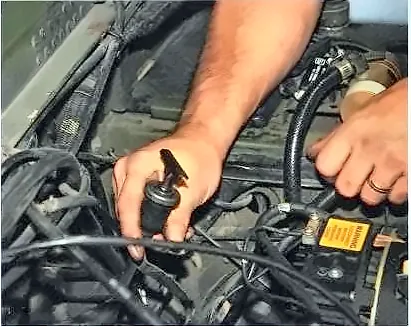
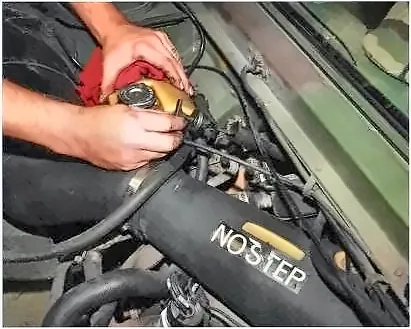
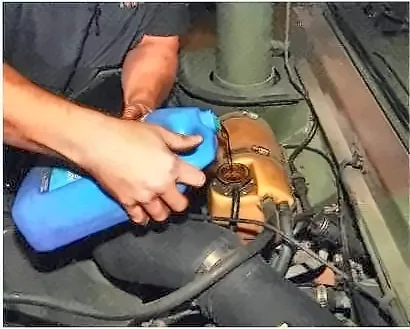
Topping up the cooling system via the radiator surge tank.
Photo: Jim Alexander · page 144 · p144-img03
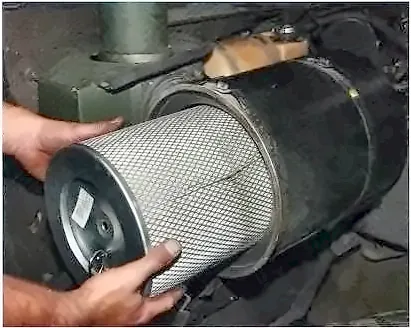
Fitting a new air-cleaner element.
Photo: Jim Alexander · page 144 · p144-img04
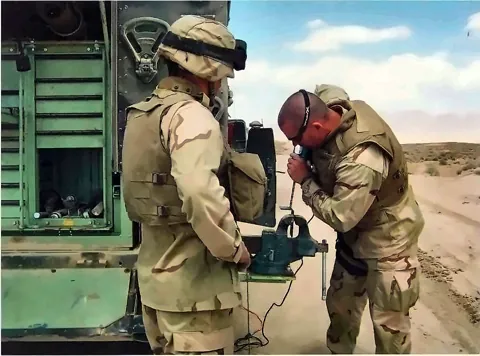
The US Marine Corps 'shop equipment contact maintenance and repair' (SECM) truck is equipped with facilities such as flame-cutting and welding tools, as well as carrying maintenance and repair parts and tools to keep vehicles running without returning to base.
Photo: US Department of Defense · page 145 · p145-img01
Squinting through the sights of a TOW missile launcher, US Army Specialist Wagner checks out an approaching convoy in Riyahd, Iraq, April 2007. The vehicle is an M1114 with the 'objective gunner protection kit'.
Photo: US Department of Defense · page 146 · p146-img01
Squinting through the sights of a TOW missile launcher, US Army Specialist Wagner checks out an approaching convoy in Riyahd, Iraq, April 2007. The vehicle is an M1114 with the 'objective gunner protection kit'.
Photo: US Department of Defense · page 147 · p147-img01
Students on the US Air Force Advanced Contingency Skills Training Course 07-2C participate in training for convoy operations on a range at Fort Dix, New Jersey; May 2007.
Photo: US Department of Defense · page 149 · p149-img01
With fuel consumption in the order of 9.4–12mpg (4–5.1km/litre), there is no denying that the Humvee is a thirsty beast. The 25 US gallon (20.7 Imperial gallon, 95 litre) tank gives a range of 235–300 miles (380–483km)... and for most owners a private fuel supply would be most welcome!
Photo: US Department of Defense · page 150 · p150-img01
Only the Marine Corps vehicles carry an external registration number.
Photo: David Doyle · page 151 · p151-img01
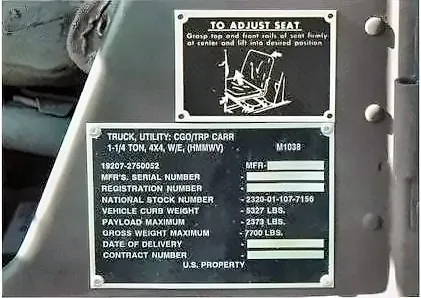
Identifying data plates are fitted inside the left-hand door opening, giving details such as the contract number, registration number and date of delivery. This plate identifies the vehicle as an M1038.
Photo: David Doyle · page 151 · p151-img02
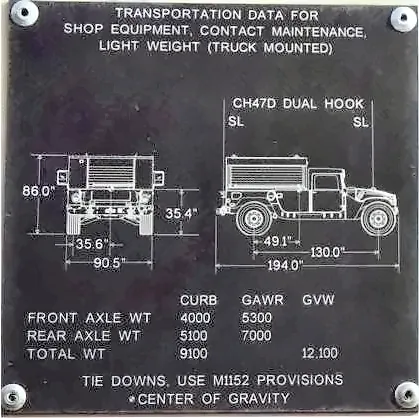
A separate data plate gives transportation and dimensional information, in this case for the ‘shop equipment contact maintenance and repair’ (SECM) truck.
Photo: David Doyle · page 151 · p151-img03
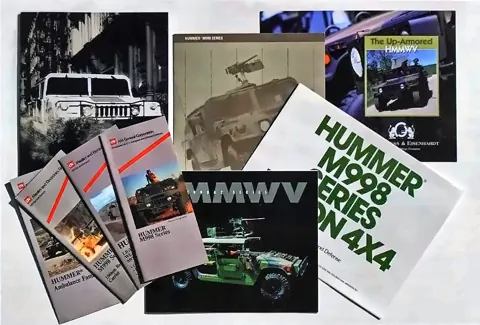
A collection of AM General’s sales material provides a quick overview of the development of the vehicle and the marketing ploys adopted by the company.
The official military documentation covering the Humvee is both comprehensive and lengthy, with most of the documents readily available in PDF form on compact disc from Military Media Inc (www.militarymanuals.com).
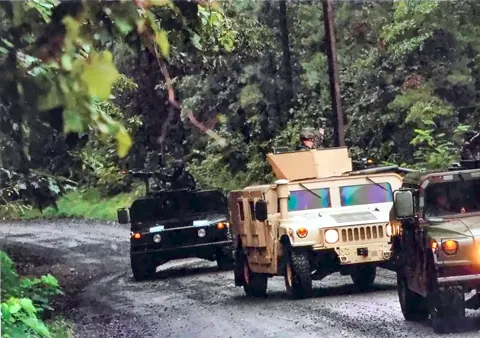
An M1025A2 TOW missile/armament carrier, basic armour, provides the lead vehicle for a short convoy of US Air Force students training at Fort Dix, New Jersey. Next in line is a sand-painted, winch-equipped M1114 up-armoured Humvee (UAH) with a gunner shield kit.
Photo: US Department of Defense · page 154 · p154-img01
An M1025A2 TOW missile/armament carrier, basic armour, provides the lead vehicle for a short convoy of US Air Force students training at Fort Dix, New Jersey. Next in line is a sand-painted, winch-equipped M1114 up-armoured Humvee (UAH) with a gunner shield kit.
Photo: US Department of Defense · page 155 · p155-img01